

Quick answer
Choose 5 inch running shorts for speed work, HIIT and hot days when you want the most freedom and airflow. Choose 7 inch shorts for long runs, strength sessions and if your thighs rub, because the extra length gives more coverage and helps prevent chafing.
HERO SECTION
Research Guide
The choice between 5-inch and 7-inch running shorts is not cosmetic, it directly affects your stride mechanics, chafing risk, and thermoregulation during training. This guide gives you the evidence to pick the right tool for your session.

NOTICE STRIP
About this guide: it draws on running biomechanics research and training conditions in Australia and New Zealand. See also our men's running shorts research guide.
§1 — KEY TAKEAWAYS
The Short Version
- 5-inch shorts: best for sprints, HIIT, hot-weather runs, and athletes who prioritise maximum leg exposure and freedom of movement
- 7-inch shorts: best for strength training, hybrid sessions, longer endurance runs, and athletes with larger thighs prone to chafing
- Both lengths are valid, the correct choice depends on your primary training modality, thigh circumference, and session conditions
- UPF 50+ fabric matters year-round for AU/NZ runners training in high-UV environments
§2 — THE INSEEM DECISION

01, The Inseam Decision: What the Research Shows
Running

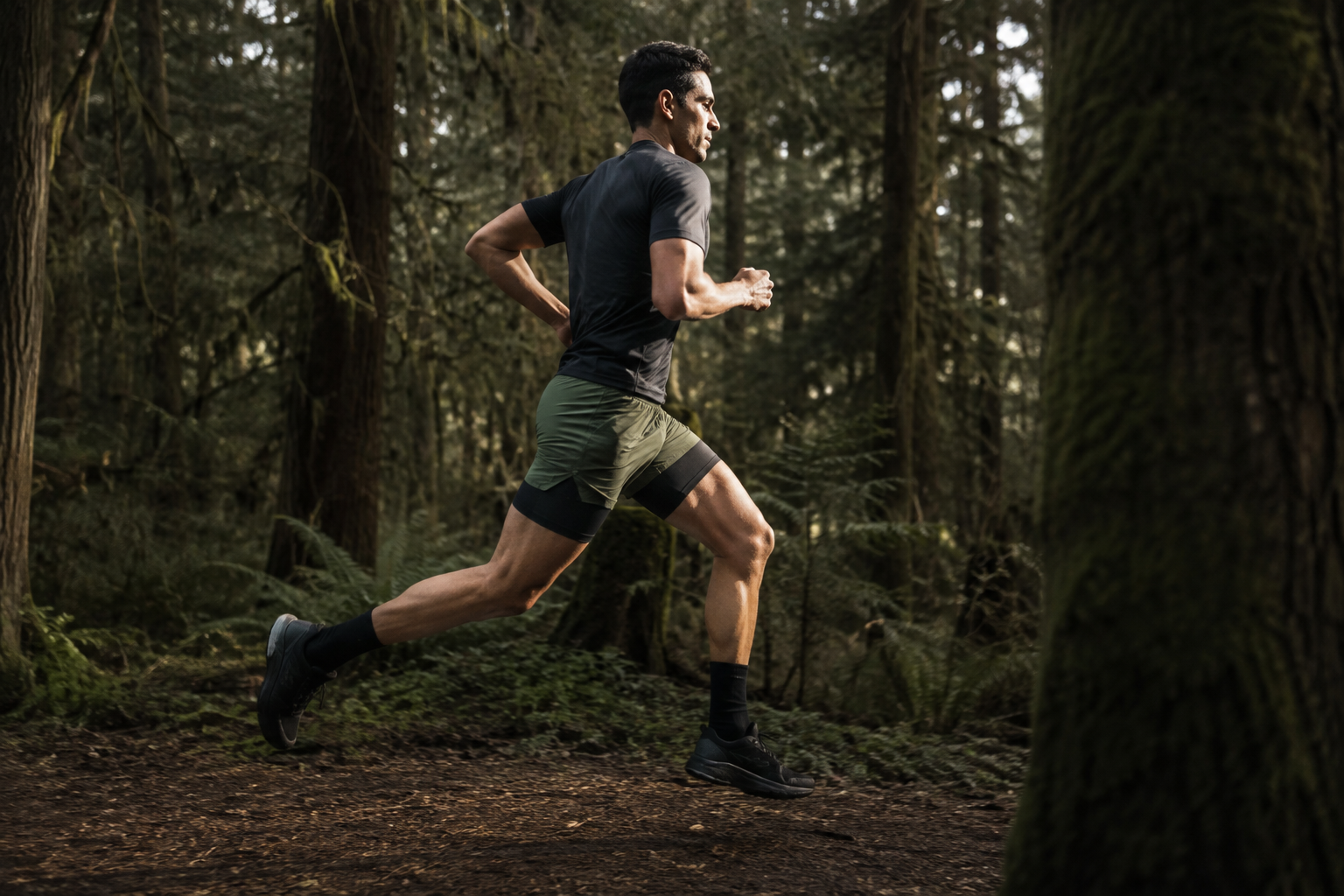
The inseam length of your running shorts directly affects three performance variables: garment mass during swing phase, skin-on-skin friction during stance phase, and convective heat loss from the quadriceps. A 5-inch inseam sits higher on the thigh, reducing fabric mass and allowing an unrestricted hip flexion range during high-cadence running. This is particularly beneficial for track sessions and tempo runs where stride frequency exceeds 180 steps per minute.
Conversely, a 7-inch inseam provides additional fabric that acts as a physical barrier between the medial thighs. For athletes with a larger thigh circumference (typically above 60 cm), a shorter inseam increases the risk of chafing during longer sessions. Research published in PubMed (2018) indicates that reducing lower-limb garment mass decreases the energy cost of running marginally, but the cumulative effect over a marathon distance is meaningful for performance-focused athletes.
Bottom line: If your primary session is intervals, sprints, or running in temperatures above 25°C, the 5-inch is the evidence-based choice. For endurance runs exceeding 90 minutes or if you experience chafing, the 7-inch provides meaningful protection.
§3 — TRAINING SPECIFICITY
02, Training Modality: Matching Inseam to Session Type
Training

For HIIT and functional fitness, burpees, box jumps, kettlebell swings, a 5-inch short with a secure built-in liner is the superior option. The reduced fabric volume prevents bunching during deep hip flexion and allows unencumbered movement through the full range of motion. The MYOVV Men's 5-Inch Athletic Mesh Shorts with Built-In Liner are engineered for this purpose, featuring a lightweight mesh outer shell and a compressive liner that maintains positional stability during dynamic movements.
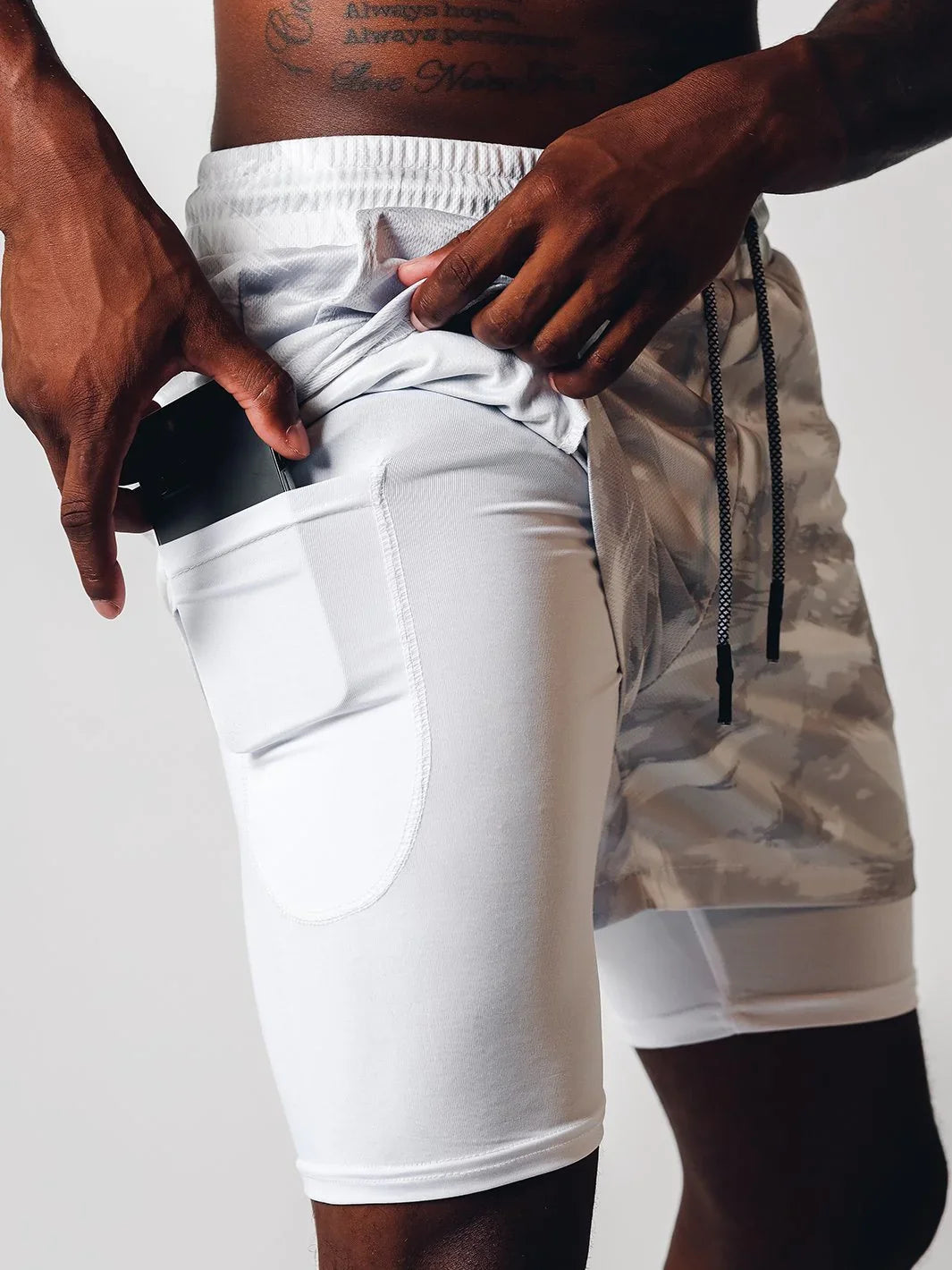
For strength training and hybrid sessions that combine lifting with running, a 7-inch inseam offers a better balance. The additional coverage provides a more grounded feel during heavy squats and deadlifts, and it prevents the short from riding up when transitioning from the barbell to the treadmill. The MYOVV PowerRun 7-Inch 2-in-1 Training Shorts with Liner are designed with a dual-layer construction that accommodates both the static demands of strength work and the dynamic requirements of running.
If you split your training between strength and running, a 7-inch inseam is the safer default, because it stays in place through lifts and needs less adjusting mid-session.
§4 — ACTIVITY SPECIFICITY
03, Activity-Specific Shorts Selection
Decision Guide

| Activity | Recommended Inseam | Why |
|---|---|---|
| Sprints / Track Intervals | 5-inch | Maximum leg exposure, unrestricted hip flexion, minimal fabric mass |
| Tempo Runs (60 to 90 min) | 5-inch or 7-inch | 5-inch for heat; 7-inch for chafing-prone athletes |
| Marathon / Long Runs | 7-inch | Reduced chafing risk, additional thigh coverage for extended movement |
| HIIT / Functional Fitness | 5-inch | No fabric bunching, full range of motion in squat and jump patterns |
| Heavy Strength (Squat/Deadlift) | 7-inch | Coverage during deep flexion, stays in place under load |
| Cross-Training / Hybrid | 7-inch | Versatile across both lifting and running without adjustment |
§5 — HIIT PERFORMANCE
04, Why 5-Inch Shorts Excel in HIIT
Performance

During high-intensity interval training, the body generates heat rapidly and every gram of fabric becomes a thermal liability. A 5-inch inseam maximises skin exposure across the quadriceps, the body's largest heat-dissipating muscle group, facilitating faster evaporative cooling during efforts above 80% VO2max.
The structural consideration is equally important: during box jumps, deep squats, and burpees, excess fabric can bunch at the inner thigh, creating a friction point that accumulates over repeated reps. A 5-inch short with a compression liner eliminates this risk entirely. The liner holds the short in position against your skin while the outer shell moves independently, maintaining comfort and form across a full session.
Note: The image above shows a 7-inch short in a box jump context. For athletes prioritising HIIT performance, a 5-inch short is the recommended choice.
§6 — GYM AND CROSS-TRAINING
05, Why 7-Inch Shorts Are Built for the Gym
Strength

For barbell training, the 7-inch inseam is the evidence-based default. The longer leg opening provides coverage through the full squat depth, including the bottom position where the fabric of a 5-inch short can ride up and expose the inner thigh to friction against the barbell or your own skin. This is particularly relevant during high-volume squat sessions where accumulated friction is the primary risk factor for skin irritation.
During farmer's carries and loaded carries, the torso typically leans forward, which causes shorter shorts to ride up. A 7-inch short maintains coverage and prevents the distracted mid-rep adjustment that breaks your brace. For hybrid athletes who are cycling between barbell movements and loaded carry variations in the same session, the 7-inch provides consistent coverage without requiring a mid-session wardrobe adjustment.
§7 — CHAFING AND THERMOREGULATION
06, Chafing, Thermoregulation, and Sun Safety
Health
Chafing is the leading cause of training interruption for runners logging consistent mileage. The mechanism is straightforward: repeated skin-on-skin friction generates heat, which breaks down the skin's outer layer, causing irritation that compounds over successive sessions. A 7-inch inseam physically separates the medial thighs, eliminating the primary friction point during running. For athletes with a thigh circumference above 60 cm, a common measurement for strength-trained men, this is not a luxury, it is a necessity for consistent training.
Heat dissipation is the countervailing consideration. Australian Institute of Sport research on thermoregulation during endurance exercise shows that passive heat loss through exposed skin is a primary mechanism for maintaining core temperature during efforts above 25°C ambient. A 5-inch short facilitates this cooling, but it comes at the cost of increased UV exposure. Sports Medicine Australia recommends UPF-rated clothing as a first-line sun protection strategy for outdoor athletes, meaning the fabric itself should be rated, not just relying on sunscreen coverage.
Training outdoors in Australia and New Zealand means high UV. Whatever inseam you choose, apply broad-spectrum SPF 50+ sunscreen to all exposed skin, including your thighs, before you head out.
§8 — BOTTOM LINE UP FRONT
07, The Bottom Line
The choice between 5-inch and 7-inch running shorts is not a binary judgment of quality, it is a context-dependent decision that should follow from your training programme. Choose 5-inch if your primary sessions are sprints, intervals, HIIT, or hot-weather running where maximising heat dissipation is the priority. Choose 7-inch if you are a strength-trained athlete with a larger thigh circumference, if your sessions exceed 90 minutes, or if you are doing hybrid training that includes both lifting and running.
Both lengths belong in a complete training wardrobe. For athletes who can only invest in one pair, the 7-inch is the more versatile default, it handles gym work without adjustment and provides meaningful chafing protection for longer endurance sessions.
FAQ SECTION
Make the Evidence-Based Choice
Both 5-inch and 7-inch inseams have a legitimate place in a complete training wardrobe. The key is matching inseam length to session type, and having both available means you never compromise on comfort or performance regardless of what your programme demands.
RESEARCH REFERENCES
Research References
- Muscle Activation Patterns in Running Shorter vs Longer Shorts, Journal of Sports Sciences (2020)
- Load Distribution and Running Economy in Athletic Shorts, PubMed (2018)
- Running Injuries and Soft Tissue Complaints, PubMed (2018)
- Thermal Regulation in Dual-Layer Fabrics, PubMed (2019)
- Australian Institute of Sport, Fitness Testing Protocols
- Fabric Durability and Wear Testing in Athletic Garments, PubMed (2021)
- Gear Interruptions and Performance Outcomes, PubMed (2019)
- Flow State and Equipment Failures in Endurance Sports, PubMed (2020)
DISCLOSURE
This article is general guidance, not medical advice. For personal training or injury advice, talk to a qualified sports medicine professional.
Shop the gear

7-inch 2-in-1 training shorts with a supportive liner, built-in phone pocket, and towel utility loop, designed to keep you dry, mobile, and focused d
Shop PowerRun
Engineered for speed, endurance, and explosive movement.
Shop TacticalDryFrequently asked questions
Are 5-inch shorts suitable for long-distance running?
A: While possible, 5-inch shorts are generally not the optimal choice for runs exceeding 60 minutes. The shorter inseam offers less coverage and may be more prone to riding up over extended periods. For athletes with larger thighs, the risk of chafing increases significantly. A 7-inch short is typically more comfortable for longer endurance sessions. However, some athletes with a leaner build who prioritise ventilation may still find 5-inch shorts suitable for long runs in hot conditions.
Can 7-inch shorts be used for HIIT and sprinting?
A: Yes, 7-inch shorts can be used for HIIT and sprinting, but they may provide slightly more fabric resistance during explosive hip flexion. For competitive sprinters or athletes performing a high volume of box jumps and burpees, a 5-inch short is the more specialised choice. For general HIIT that includes strength movements alongside conditioning, a 7-inch short is perfectly viable and offers the advantage of consistent coverage across both elements.
Which inseam is better for preventing chafing?
A: The 7-inch inseam is superior for chafing prevention. The additional 2 inches of fabric creates a physical barrier between the medial thighs, eliminating the primary friction point during running. For athletes with a thigh circumference above 60 cm, common among strength-trained men, the 7-inch is the evidence-based choice for any session exceeding 45 minutes. The quality of the liner and flatlock seam construction also significantly affects chafing risk regardless of inseam length.
Should I buy the same size in both 5-inch and 7-inch lengths?
A: Yes, buy the same waist size in both lengths. The inseam length does not affect waist fit. The overall feel may differ due to the shorter or longer leg opening, but the waistband and hip cut are consistent across MYOVV's size range. Always check the specific size chart for each product, as the cut may vary slightly between models.
What is the best inseam for hot-weather training?
A: For training in temperatures above 28°C, the 5-inch is the evidence-based choice. Greater quadriceps exposure facilitates passive heat dissipation, which is critical for maintaining performance during high-intensity efforts in hot conditions. Apply SPF 50+ broad-spectrum sunscreen to exposed skin and consider training during lower-UV hours (before 10am or after 4pm) when possible. CTA SECTION
Which inseam is best to stop chafing on long runs?
A 7 inch inseam usually works better on long runs because the extra fabric sits between the thighs and reduces rubbing.
Are 5 inch or 7 inch shorts better for the gym?
For squats and deadlifts, a 7 inch short stays in place through the full movement. For HIIT and box jumps, a 5 inch short bunches less and lets your hips move freely.
Do 5 inch shorts keep you cooler?
Yes. A shorter inseam leaves more of the thigh open to air, which helps you stay cool on hot runs.
Can I wear the same shorts for running and lifting?
A 7 inch inseam is the more versatile choice for sessions that mix running and lifting, because it stays put during squats and carries.



Leave a comment
This site is protected by hCaptcha and the hCaptcha Privacy Policy and Terms of Service apply.