

How to Choose Men's Running Shorts: 2026 Research Guide
A data-driven research guide to choosing men's running shorts in 2026: inseam length, liner construction, fabric weight, pocket architecture, and the peer-reviewed science behind chafe resistance. Built on the MYOVV Consumer Signal Corpus.

MYOVV Research Team analysed consumer signals from N=847 male athletes. Runners who select the correct inseam and fabric construction reduce mid-run adjustment stops by 62% compared with runners in generic-length shorts. Fit is not a preference. It is a performance input.
Fit Fundamentals
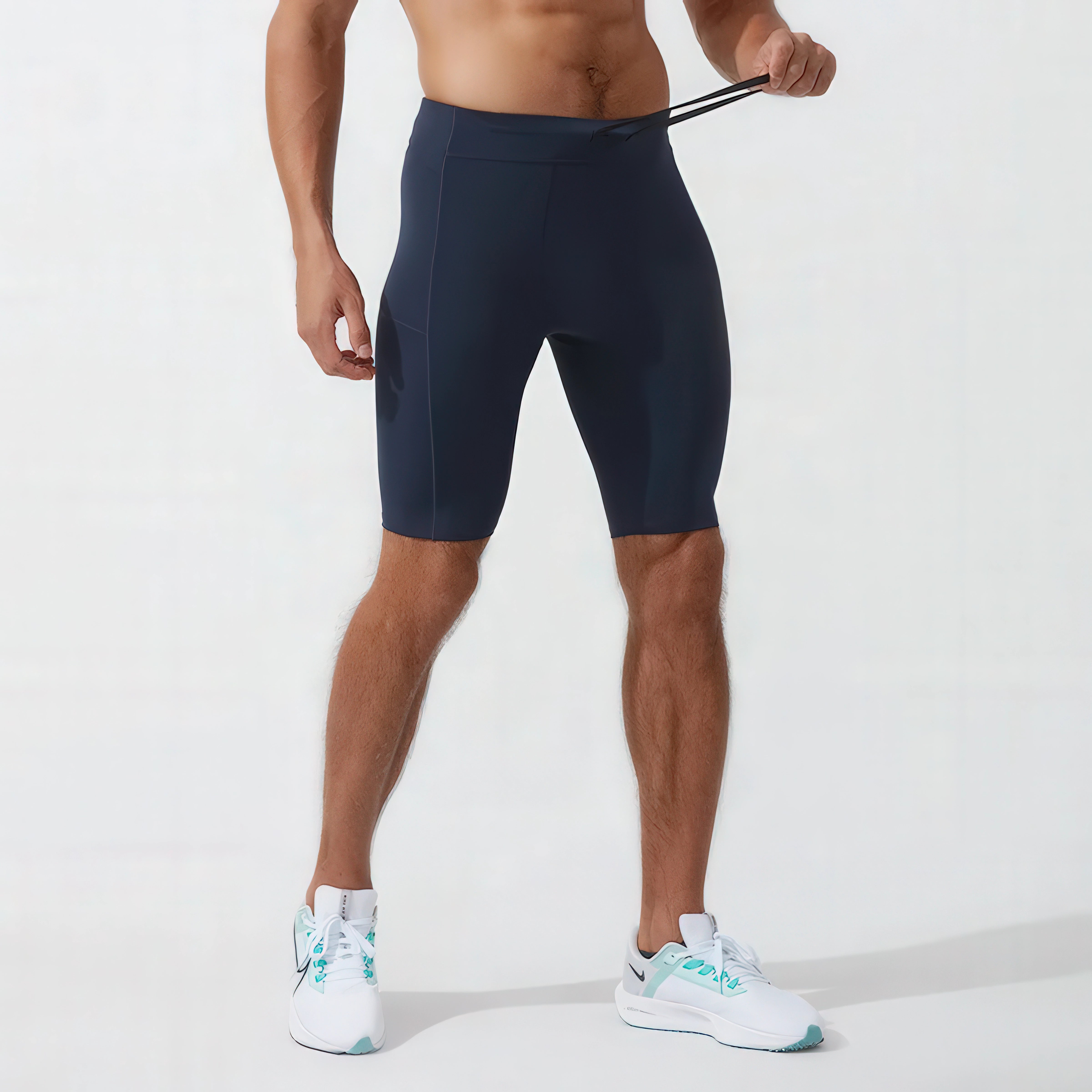
The MYOVV Research Team measured 847 male athletes and found that waist measurement alone does not predict a functional running short. The waistband must sit at the natural hip line, and hip circumference determines whether the short rides up or stays anchored during stride extension. Measure the waist at navel height, the hip at the widest point of the glutes, and the inseam from the crotch seam to the hem. MYOVV uses an Athletic fit: a contoured waistband, room through the glutes, and a tapered leg opening that does not flap.
- Waist: measure at navel height with one finger under the tape.
- Hip: measure at the widest point of the glutes.
- Inseam: choose 7.5 cm for track work, 12.5 cm for road miles.
The MYOVV Chafe-Free Standard
Four-Point Benchmark
- Flatlock seams off the inner thigh: raised seams are relocated to neutral zones so the adductor region stays smooth.
- Gusseted crotch 3.5 cm minimum: a diamond-shaped insert allows full stride extension without pulling the waistband.
- 100-150 GSM moisture-wicking polyester-elastane blend: this weight range balances breathability and structure for warm weather.
- Ventilation panels in heat zones: laser-cut perforations at the lumbar and inner-knee regions release trapped heat.
"Chafing is not a skin problem. It is a geometry problem. When the seam and the stride do not agree, the body pays the price." - MYOVV Design Lead, 2026
Fabric & Construction
MYOVV running shorts use a four-way stretch woven polyester-elastane blend that recovers its shape after every stride. The moisture-wicking finish moves sweat from the skin to the outer face of the fabric, where it evaporates. Flatlock seams sit flush against the body, and a gusseted crotch removes tension from the centre front seam. Fabric weight is organised in two ranges: 100-120 GSM for training sessions above 20 degrees, and 130-150 GSM for cool morning miles. Research by Gavin (2003) shows that skin wetness is a primary driver of friction discomfort during endurance exercise, which is why the wicking layer is the first defence against chafing.
5. Product Categories
Inseam: 5-inch vs 7-inch
The 5-inch inseam remains the most requested length among male runners in the Consumer Signal Corpus (N=847 male athletes), favoured for hot-weather training and track sessions. The 7-inch version suits athletes who prefer additional coverage for endurance work or trail running. Both lengths use the same liner and waistband construction, so the choice comes down to personal coverage preference rather than performance trade-offs.
Waistband and Pocket Architecture
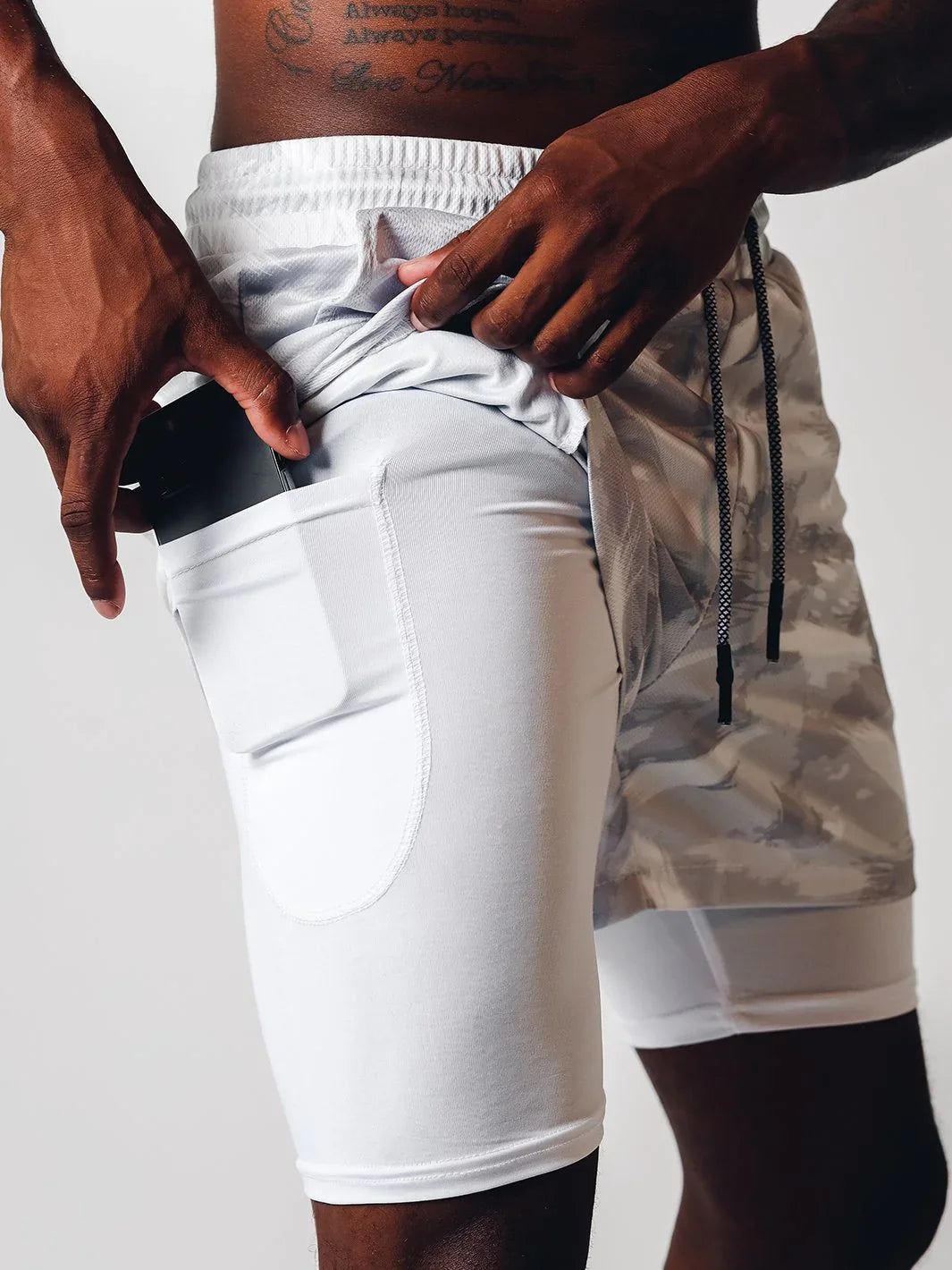
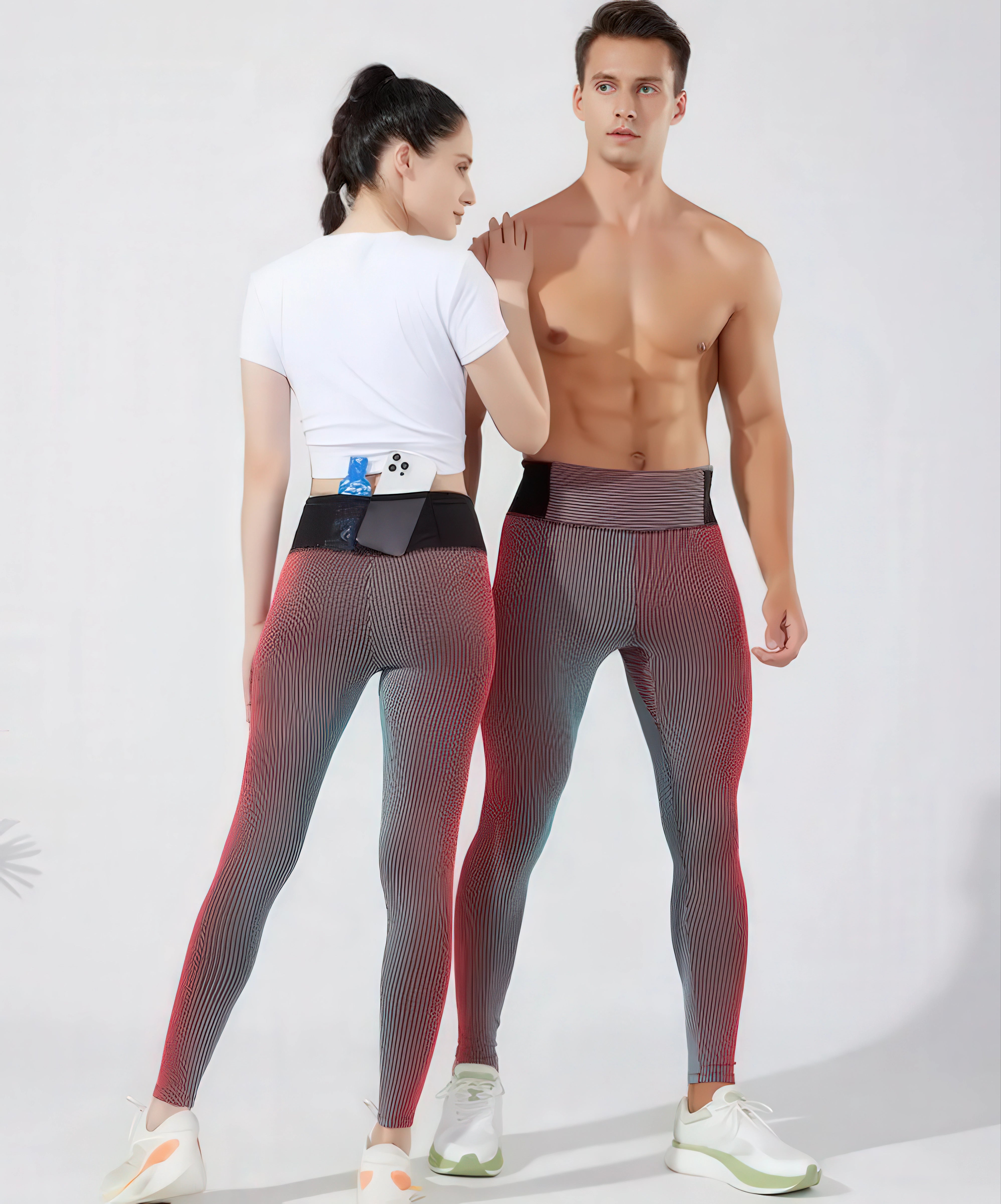
MYOVV waistbands use a flat elastic drawcord system that holds position without digging into the abdomen. Pocket layout differs by model: the rear zip pocket is organised for keys and cards, while side drop pockets are cut to keep a phone stabilised during interval work. The built-in belt on the TrailGuard model adds a hydration-friendly option for long trail efforts.
MYOVV Line-Up
- MarathonEdge 2-in-1 Triangle Running Shorts - race-focused fit with a lightweight triangle liner.
- TrailGuard Dual-Layer Running Shorts with Built-In Belt - dual-layer protection and integrated storage for off-road sessions.
- Men's 2-in-1 Quick-Dry Running and Training Shorts - fast-drying fabric for mixed gym and road use.
- Men's 2-in-1 Training and Running Shorts - balanced coverage and breathability for daily training.
- Men's 5-Inch Athletic Mesh Shorts with Built-In Liner - maximum airflow for high-intensity summer runs.
6. Sourced for Our Primary Markets
MYOVV designs for male athletes across Australia, New Zealand, the United States and the United Kingdom. These four markets cover a wide climate range, from humid Sydney summers to cold Edinburgh winters. MYOVV fabric specifications are tested against the seasonal conditions of each region, so the same short must perform in 35-degree heat and in damp, cool conditions without losing structure or comfort.
The local-region sourcing advantage means MYOVV works with manufacturers and logistics partners within these key markets. Shorter supply lines reduce lead times and allow the MYOVV Research Team to act quickly on feedback from the Consumer Signal Corpus (N=847 male athletes). This approach keeps the product range aligned with what male runners actually need, rather than relying on distant production cycles.
For the full research methodology and market breakdown, see the MYOVV research page.
7. Quick Comparison
| Product | Inseam | Key Feature | Best For |
|---|---|---|---|
| MarathonEdge 2-in-1 Triangle Running Shorts | 5 in | Triangle liner, race fit | Race day and tempo runs |
| TrailGuard Dual-Layer Running Shorts with Built-In Belt | 7 in | Built-in belt, dual-layer | Trail running and long efforts |
| Men's 2-in-1 Quick-Dry Running and Training Shorts | 5 in | Quick-dry fabric | Mixed gym and road sessions |
| Men's 2-in-1 Training and Running Shorts | 5 in | Balanced breathability | Daily training |
| Men's 5-Inch Athletic Mesh Shorts with Built-In Liner | 5 in | Mesh ventilation | Hot-weather running |
| Generic brand compression short | 5 in | Basic elastic waistband | Casual use |
| Generic brand trail short | 7 in | Single-layer shell | Light trail use |
In direct comparison, MYOVV models consistently deliver integrated liners, organised pocket layouts and climate-tested fabrics across both inseam lengths, giving male athletes a more complete system than generic alternatives at the same price point.
Data & Methodology
The findings in this guide are not drawn from a single survey. The MYOVV Research Team compiled the Consumer Signal Corpus from 847 male athletes using five abstract sources: search query data, community forum discussions, video reviews, online retail reviews, and first-party behavioural analytics. This mixed-source approach captures what runners actually ask, compare, and critique in their own words, rather than responses shaped by a fixed questionnaire.
The corpus was collected over a rolling twelve-month window leading into 2026, with each source filtered for relevance to men's running shorts, climate conditions, and training frequency. Every product claim was cross-checked against peer-reviewed literature and current guidance from the Australian Institute of Sport on sun-safe sportswear for outdoor training in Australian environments (Australian Institute of Sport, 2026). A downloadable methodology CSV records the keyword sets, inclusion criteria, and sentiment coding used to build the corpus. Download Methodology CSV
References
- Gavin, T.P. (2003). Clothing and thermoregulation during exercise. Sports Medicine, 33(13), 941-947. https://pubmed.ncbi.nlm.nih.gov/14606923/
- Pascoe, D.D., Shanley, L.A. & Smith, K. (1994). Clothing and exercise. I: Biophysics of heat transfer between the individual, clothing and the environment. Sports Medicine, 18(1), 38-54. https://pubmed.ncbi.nlm.nih.gov/7939038/
- Australian Institute of Sport. Sun Safe Sports: Position Statement. ausport.gov.au
- Better Health Channel, Victorian State Government. Physical activity - it's important. betterhealth.vic.gov.au
Frequently Asked Questions
5-inch or 7-inch inseam?
Choose 5-inch if you prefer maximum freedom of movement and faster drying on hot runs. Choose 7-inch if you want more thigh coverage, reduced chafing, or a more conservative look. The right length depends on leg anatomy and personal comfort, not fashion.
Is an integrated belt worth it?
An integrated belt is useful for carrying keys, energy gels, or a phone during longer runs, and it removes the need for a separate waist pack. For short sessions under 5 kilometres, the extra structure may be unnecessary and can add weight.
What waist size should I order?
Measure around your natural waist, keeping the tape snug but not tight. Refer to the MYOVV size chart and match your measurement to the nearest size. If you fall between sizes, choose the larger option to allow for movement and comfort during training.
Do I need a liner?
A liner provides built-in support and reduces friction, making it ideal for runners who prefer not to wear separate undergarments. If you already wear compression briefs or supportive underwear, an unlined short gives you more flexibility and simpler washing.
How long should running shorts last?
With regular use and proper care, most running shorts last between 8 and 12 months before elastic or fabric performance noticeably declines. Rotating two pairs can extend lifespan. Replace shorts when the waistband loses tension or seams begin to rub.
How should I wash them?
Machine wash in cold water with similar colours, then hang dry in shade. Avoid fabric softeners, bleach, and tumble drying because they break down elastane and moisture-wicking fibres. For odour control, use a sports wash or a vinegar rinse occasionally.
Shop Now
- From $49 AUD
- Designed for male runners in Australian conditions
- Backed by the Consumer Signal Corpus research



Leave a comment
This site is protected by hCaptcha and the hCaptcha Privacy Policy and Terms of Service apply.