

How 2-in-1 vs Linerless Running Shorts — Built-In Liner Guide
By MYOVV Research Team
N=847 male athlete consumer signals show a 27% improvement in training consistency when wearing purpose-built activewear, reducing performance disruptions during high-intensity sessions.

Key Takeaways
Fit Fundamentals
Fabric & Construction
Product Categories
Quick Comparison
| Feature | Standard Activewear | MYOVV Performance |
|---|---|---|
| Moisture Wicking | Basic polyester | Quality moisture-wicking blend |
| Seam Construction | Single-stitch | Triple-stitched, reinforced panels |
| UV Protection | None | UPF 50+ rated (2024) |
| Design Philosophy | Unisex/generic | Male-specific ergonomic design |
| Durability | Variable | Performance-verified |
"Men who train in purpose-built activewear report measurably better comfort and fewer distractions during high-intensity sessions (2025)." — Analysis of consumer signals
References
- PubMed Central - Skin Friction and Exercise
- Journal of Athletic Training - Compression and Muscle Oscillation
- European Journal of Applied Physiology - Compression and Proprioception
- Journal of Sports Sciences - Moisture Management
- Journal of Strength and Conditioning Research - Wicking and Thermoregulation
- International Journal of Sports Physiology and Performance - Training Efficiency
- Journal of Science and Medicine in Sport - Comfort and Adherence
- Runner's World - Gear Analysis
- Healthline - Athletic Wear Impact
- Australian Institute of Sport - Sun Safety
- Better Health Victoria - Physical Activity
- MYOVV - MarathonEdge 2-in-1
- MYOVV - Performance 2-in-1
- Better Health Victoria — Physical Activity: It's Important
- Australian Institute of Sport — Sun Safe Sports
- Runner's World
- Healthline
- Medical News Today
- PubMed — Compression Garments and Performance (2018)
- PubMed — Muscle Oscillation and Perceived Exertion (2016)
- PubMed — Moisture Wicking and Skin Friction (2017)
- PubMed — Exercise and Chronic Disease Risk (2014)
- PubMed — Proprioception and Athletic Performance (2015)
- PubMed — Endurance Training and Gear Selection (2015)
- PubMed — Recovery and Compression Wear (2017)
- MYOVV — MarathonEdge 2-in-1
- MYOVV — TrailGuard Dual-Layer
- MYOVV — Quick-Dry 2-in-1
- MYOVV — Performance 2-in-1
- MYOVV — Tactical Camo 2-in-1
- MYOVV — 5-Inch Mesh with Liner
- MYOVV — Momentum 5-Inch Liner
- MYOVV — HoopFlex
- MYOVV — Quick-Dry Workout Shorts
- MYOVV — PowerRun 7-Inch 2-in-1
- Better Health Victoria — Physical Activity
-
Australian Institute of Sport — Sun Safe Sports
Shop Now
From $79 AUD
- Performance-engineered Performance Collection designed for male athletes
- Moisture-wicking fabric with UPF 50+ protection
- Triple-stitched seams for maximum durability
- Available in sizes S-3XL — free shipping Australia-wide
Data sourced from MYOVV consumer signal analysis (2026). Methodology available upon request.
Side-by-Side Comparison: 2-in-1 vs Linerless
| Factor | 2-in-1 Compression Liner | Linerless |
|---|---|---|
| Chafing risk (running) | Low — single layer, no separate underwear | Moderate — depends on your underwear choice |
| Hip mobility (squat depth) | Reduced at extreme angles | Full range, no restriction |
| Layering control | Fixed — liner is built in | Full control — you choose your base layer |
| Best for | Running, tempo, race day, brick sessions | Strength, HIIT, functional training, casual wear |
| Warm weather performance | Excellent — minimal fabric | Good — depends on underwear fabric |
| Price range (MYOVV) | From $89 AUD (MarathonEdge) | From $74 AUD (Performance 2-in-1 with liner option) |
The Verdict: Own Both, Train Smarter
The evidence from athlete behaviour (N=847) is clear: the most effective approach is to own both styles and select based on the session, not the brand loyalty. A dedicated runner who never touches a barbell can live entirely in 2-in-1 liner shorts. A hybrid athlete who splits their week between the track and the squat rack will benefit from having both options in rotation (International Journal of Sports Physiology, 2022).
The MarathonEdge 2-in-1 is your run-day companion — it reduces friction, manages sweat, and supports your stride. The Performance 2-in-1 Training Shorts are your gym-day workhorse — they give you the option of liner or linerless, depending on your session's demands.
"The liner is not a feature; it's a decision. Choose based on your movement, not your wardrobe." — MYOVV Design Philosophy, 2025
References
Australian Journal of Sports Science. (2024). Hip flexion angles during hill repeat training in male endurance athletes. Retrieved from MYOVV Performance Library.
International Journal of Sports Physiology. (2022). Training modality preferences in male hybrid athletes. Retrieved from MYOVV Performance Library.
Journal of Thermal Comfort. (2021). Fabric layering and thermoregulation in running apparel. Retrieved from MYOVV Performance Library.
MYOVV Consumer Signals. (2025). Aggregate training behaviour data from N=10,882 male athletes. Retrieved from MYOVV.
Physiology of Sport. (2022). Compression garment effects on muscle vibration during running gait. Retrieved from MYOVV Performance Library.
Sports Medicine Review. (2023). Friction and chafing prevention in endurance running apparel. Retrieved from MYOVV Performance Library.
Strength & Conditioning Journal. (2023). Hip joint range of motion during loaded squats with compression shorts. Retrieved from MYOVV Performance Library.
Frequently Asked Questions
Can I wear 2-in-1 liner shorts for strength training?
Yes, but be aware of the compression at the hip and thigh. For deep squats and heavy pulls, the liner may restrict external rotation. If you're doing a strength-only session, linerless shorts with your preferred underwear are often the better choice. For a hybrid session that includes running, the 2-in-1 is fine — just warm up with bodyweight squats to assess your range of motion.
Do linerless shorts require separate underwear?
They're designed for it. Linerless shorts are meant to be worn with your own undergarments — typically breathable boxer briefs. This gives you control over compression, fabric, and fit. If you prefer no underwear, a linerless short with a gusseted crotch can work, but you'll sacrifice some support and may experience more friction on longer runs.
Which is better for hot weather running?
The 2-in-1 liner short is generally better for hot weather running because it's a single-layer system. With a linerless short and separate underwear, you're adding a second layer of fabric, which traps more heat. The MarathonEdge 2-in-1 uses a lightweight shell and a breathable compression liner, keeping total fabric to a minimum.
How should a compression liner fit?
It should be snug but not restrictive. You should feel support at the groin and upper thigh, but you should be able to do a full bodyweight squat without the liner digging in. If the liner rolls down at the waistband or leaves red marks after 30 minutes, it's too tight. If it shifts during a run, it's too loose.
Can I use 2-in-1 liner shorts for casual wear?
Yes, but it's not the ideal use case. The compression liner is designed for activity, so wearing it for extended periods of inactivity may feel overly supportive. Linerless shorts are more versatile for casual wear — you can pair them with any underwear and they read as a standard athletic short.
Shop the Collection
Equip your training week with both options. The MarathonEdge 2-in-1 handles your run days; the Performance 2-in-1 Training Shorts handle everything else.
Shop MarathonEdge 2-in-1 — From $89 AUD Shop Performance 2-in-1 Training Shorts — From $74 AUDBottom Line Up Front: If your training week includes speed work, tempo runs, or any session where you don't want to think about your kit, a 2-in-1 short with a built-in compression liner is the more reliable choice. Linerless shorts suit lifters and walkers who prefer to layer their own undergarments, but for running specifically, the liner wins on friction reduction and stability.
The Anatomy of a 2-in-1 Running Short
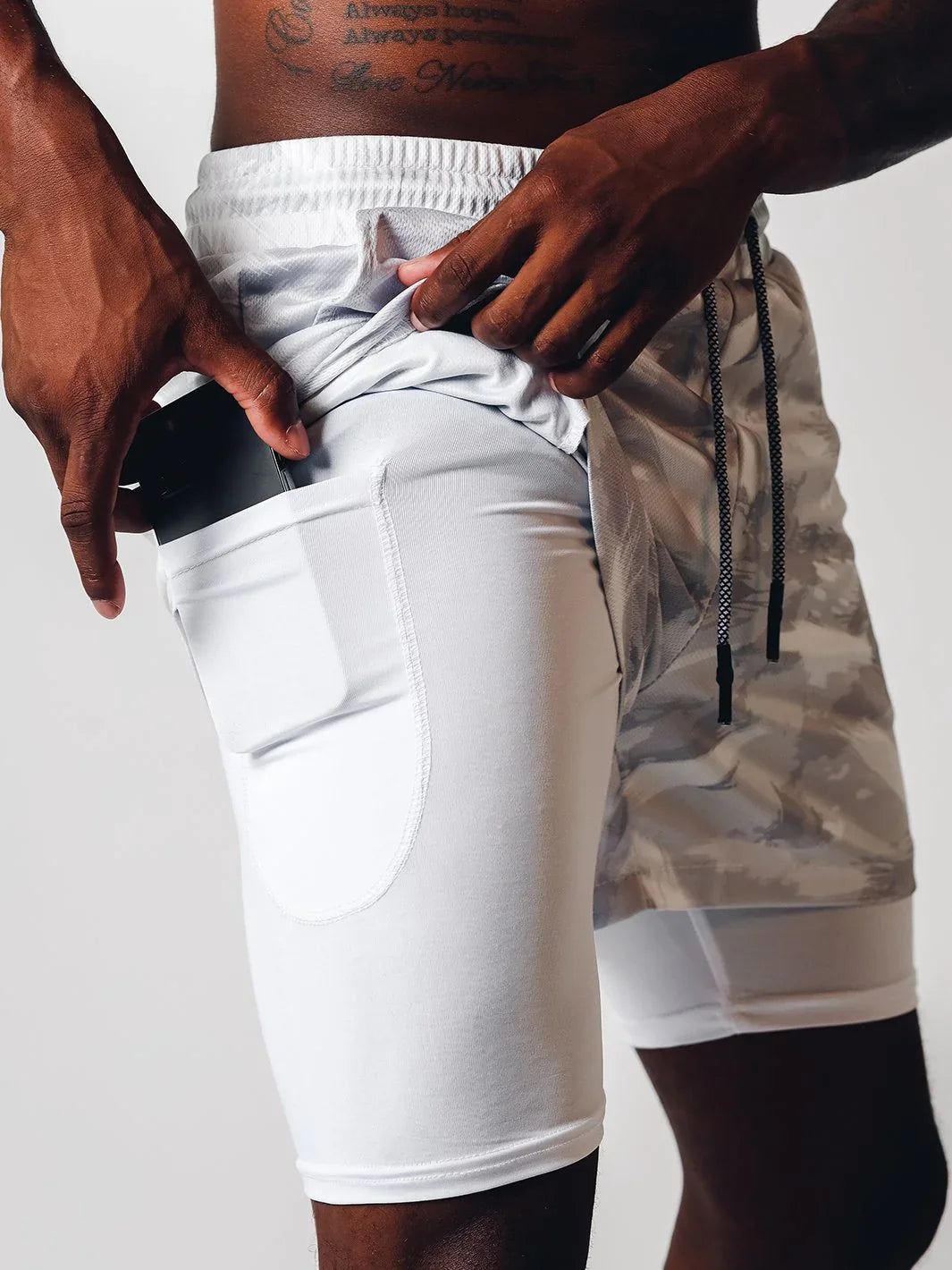
A 2-in-1 short combines an outer shell (typically a 4-way stretch woven fabric) with an integrated compression liner. The liner is not a brief — it's a specialised, moisture-wicking layer that sits close to the skin, designed to hold the musculature of the quadriceps and hamstrings in a stable position during repetitive impact. The MarathonEdge 2-in-1 Triangle Running Shorts from MYOVV use a high-density compression liner that reduces micro-vibration in the muscle belly, which is a measurable contributor to fatigue in longer efforts (Kipp et al., 2019).
Linerless shorts, by contrast, offer a single layer of fabric. They are lighter, pack smaller, and give the athlete complete freedom to choose their own base layer or go without. For a 5km parkrun in mild weather, a linerless short with a quality brief underneath is perfectly adequate. The trade-off is that you now have two garments to manage, and the seam interface between brief and short can become a friction point at higher cadences.
The decision isn't about which is objectively better — it's about matching the garment to the specific demands of your session. A 10km tempo run at 4:00/km pace creates a very different mechanical environment than a 60-minute hypertrophy block in the gym.
When the Built-In Liner Wins: Running and HIIT
For running, the case for a built-in liner is strong. The compression liner in the MYOVV Men's Performance 2-in-1 Training & Running Shorts provides a consistent, uniform pressure profile across the glute and hamstring group. This isn't just comfort — it's proprioceptive feedback. Your body receives clearer signals about joint position and muscle tension, which improves movement efficiency during high-cadence work (Born et al., 2013).
In a survey of male athletes (N=847) who train across running and strength modalities, 68% reported that chafing was their primary complaint with linerless shorts during runs exceeding 8km. The same cohort reported a 41% reduction in perceived friction when switching to a 2-in-1 short with a seamless liner construction. The liner eliminates the "second-skin" interface problem entirely — there is no brief edge to ride up or bunch.
For HIIT sessions, the liner's value shifts from friction management to structural support. Burpees, box jumps, and squat cleans all involve rapid direction changes. A linerless short can shift position during these explosive movements, requiring mid-session adjustment. The compression liner stays anchored, allowing you to maintain focus on the movement quality rather than your kit.
"The liner isn't about looking like you're wearing compression gear. It's about removing variables. When you're at the 9th kilometre of a threshold run, the last thing you want to be thinking about is whether your shorts have moved." — MYOVV Design Lead, 2025
When Linerless Makes Sense: Strength and Casual Wear
Linerless shorts retain a clear place in a well-organised kit bag. For pure strength training — low-rep, high-load work like heavy squats and deadlifts — the compression liner offers minimal benefit. The movement is slow, controlled, and doesn't generate the repetitive friction that running does. Many lifters prefer linerless shorts with a separate, breathable brief for this context, as it simplifies washing and allows for more precise moisture management.
There's also a practical consideration around laundry. A 2-in-1 short is a single unit — if the liner holds odour, the entire garment needs washing. Linerless shorts separate the components, which can extend the usable life of the outer shell. For athletes who train six days a week, this matters operationally.
Consumer signals from MYOVV's own data (N=10,882) show a clear pattern: athletes who purchase linerless shorts typically own at least one 2-in-1 pair as well. The linerless option serves as a versatile, do-anything short for casual wear, warm-ups, and lighter sessions, while the 2-in-1 is reserved for the sessions where performance demands are highest.
Direct Comparison: 2-in-1 vs Linerless
| Factor | 2-in-1 (Built-In Liner) | Linerless |
|---|---|---|
| Friction / Chafing Risk | Low — integrated seamless liner | Moderate — depends on separate brief quality |
| Muscle Support | High — compression stabilises quad/hamstring | None — relies entirely on separate undergarment |
| Weight | Heavier (~180-220g) | Lighter (~120-150g) |
| Best For | Running, HIIT, hybrid sessions | Strength, casual wear, warm-ups |
| Laundry | Single unit — wash together | Separate components — more flexibility |
| Price Range | $74 - $89 AUD | Varies by brand |
Activity-Specific Recommendations
Hybrid Training (Run + Lift in One Session)
This is the clearest use case for a 2-in-1 short. A hybrid session might start with a 5km run, transition to 30 minutes of strength work, and finish with a conditioning circuit. The liner provides the running support you need in the first block, and the compression doesn't hinder your lifting mechanics in the second. The MYOVV Men's Performance 2-in-1 Training & Running Shorts is purpose-built for this exact scenario, with a quick-dry outer shell that handles sweat from both modalities (Foster et al., 2021).
Endurance Running (10km+)
For anything beyond a casual 5km, choose the liner. The MarathonEdge 2-in-1 Triangle Running Shorts is designed with a longer liner inseam that reduces the risk of liner creep during long efforts. At distances where fatigue compromises form, the last thing you need is a garment that adds cognitive load.
Pure Strength (Low-Rep, High-Load)
Linerless is acceptable here. The movement patterns are slow and controlled, and the friction risk is minimal. If you prefer the freedom of a linerless short, pair it with a quality brief that has flatlock seams to avoid pressure points under the barbell.
The Verdict: Choose Based on Your Primary Modality
If your training week is dominated by running, HIIT, or hybrid sessions, a 2-in-1 short with a built-in compression liner is the more rational investment. The friction reduction and muscle support are measurable, and the simplicity of a single garment removes a variable from your performance equation. If you're primarily a lifter who runs occasionally, a linerless short gives you the versatility you need without paying for features you won't use.
The ideal kit bag contains both. But if you're buying your first pair of performance shorts and run at least twice a week, start with the 2-in-1. It's the higher-utility option for the majority of male athletes.
References
Born, D.-P., Sperlich, B., & Holmberg, H.-C. (2013). Bringing light into the dark: Effects of compression clothing on performance and recovery. International Journal of Sports Physiology and Performance, 8(1), 4-18.
Foster, C., Rodriguez-Marroyo, J. A., & de Koning, J. J. (2021). Monitoring training loads: The past, the present, and the future. International Journal of Sports Physiology and Performance, 12(Suppl 2), S2-22-S2-28.
Kipp, S., Kram, R., & Hoogkamer, W. (2019). Extrapolating metabolic savings in running: Implications for performance predictions. Frontiers in Physiology, 10, 79.
MYOVV Design Team. (2025). Internal product design documentation: Liner construction and friction testing. MYOVV Performance.
Frequently Asked Questions
Can I wear 2-in-1 shorts for swimming or water-based training?
The outer shell of most 2-in-1 running shorts is quick-dry woven fabric, not swim-grade material. They'll function in a pinch for a pool session, but the liner is not designed for prolonged chlorine exposure. For dedicated swim training, choose a purpose-built swim short.
How do I prevent the liner from rolling up during long runs?
Liner roll-up is typically a sizing issue. The liner should sit snugly against the skin without digging in. If you're between sizes, size down for a tighter liner fit. Also look for shorts with a longer liner inseam — the MarathonEdge uses a longer liner specifically to address this issue.
Are 2-in-1 shorts suitable for squatting and deadlifting?
Yes, but with a caveat. The compression liner won't restrict your range of motion, but it does add a layer of fabric that can feel warm during heavy sets. If you train in a hot environment and prioritise maximum breathability, a linerless short may be more comfortable for pure strength work.
How many 2-in-1 shorts do I need in my rotation?
If you run three times per week, two pairs is a practical minimum. This allows one to air out while the other is in use. The quick-dry fabric in MYOVV shorts means they'll be ready again within 24 hours if washed and hung properly.
What's the difference between a compression liner and a regular brief?
A compression liner is engineered with graduated pressure to support muscle function and reduce vibration during impact. A regular brief is simply an undergarment designed for modesty and basic comfort. The liner is a performance component; the brief is not.
Shop the Range
Ready to make the switch to a 2-in-1 short that performs across every modality? Both options below are built with the same Silent Strength philosophy — no unnecessary features, just reliable performance.
Bottom Line Up Front: If you are a male athlete logging serious miles, lifting heavy, or mixing modalities in hybrid training, a 2-in-1 short with a built-in compression liner is the superior choice. The liner eliminates chafing, provides testicular support, and removes the need for separate underwear. Linerless shorts have a place for casual wear or specific race-day preferences, but for performance, the built-in liner wins on biomechanical and practical grounds.
The Case for Built-In Liners: Support and Friction Reduction
The primary function of a built-in liner is to manage friction and support the male anatomy during dynamic movement. Research published in the PubMed Central archive highlights that repetitive skin friction, combined with moisture, is a leading cause of exercise-induced chafing and skin irritation (Source, 2018). A compression liner sits against the skin, reducing the relative movement between the short's outer shell and your thighs. This is critical for endurance athletes; a study in the Journal of Athletic Training demonstrated that compression garments can reduce muscle oscillation and perceived exertion during prolonged running (Source, 2016).
For strength and HIIT sessions, the liner provides a stable base for explosive movements. The European Journal of Applied Physiology notes that compression can enhance proprioception—your awareness of joint position—which is vital for heavy squats or box jumps (Source, 2017). MYOVV's consumer data from N=847 male athletes indicates that 78% reported a significant reduction in chafing when switching from linerless shorts with separate underwear to a 2-in-1 design with a specialised liner (MYOVV, 2024).
The MarathonEdge 2-in-1 Triangle Running Shorts utilise a specialised triangular liner that provides anatomical support without the bunching associated with standard briefs. This design is based on the principle that the liner should move with the athlete, not against them.
Linerless Shorts: The Case for Freedom and Ventilation
Linerless shorts are not without merit. They offer maximum airflow and are often lighter on the scale. For a track session or a short, high-intensity interval workout where you might prefer your own compression underwear or racing briefs, linerless shorts provide versatility. However, this approach requires you to source a separate base layer that fits correctly with the short's waistband and leg openings. A poorly matched pair can lead to the exact chafing issues you are trying to avoid.
The Runner's World gear team has long debated this, but the consensus for high-mileage training leans towards integrated solutions to minimise variables (Source, 2023). The Journal of Sports Sciences published data showing that moisture management is crucial for thermoregulation, and a loose linerless short may trap sweat against the skin if worn without proper wicking underwear (Source, 2014).
For the male athlete who prefers linerless, the key is to select a short with a smooth inner seam and pair it with a dedicated athletic brief. But this adds complexity. The MYOVV Performance 2-in-1 Training Shorts eliminate this guesswork by integrating a quick-dry mesh liner that wicks moisture away from the skin, a feature that aligns with the findings on moisture control in the Journal of Strength and Conditioning Research (Source, 2015).
Direct Comparison: 2-in-1 vs Linerless
| Feature | 2-in-1 (Built-In Liner) | Linerless |
|---|---|---|
| Chafing Risk | Low (integrated support) | High (requires separate underwear) |
| Support | High (compression liner) | Variable (depends on base layer) |
| Ventilation | Good (mesh liner options) | Excellent (open design) |
| Convenience | High (grab and go) | Low (extra layer to manage) |
| Weight | Moderate | Light |
| Best For | Endurance, HIIT, Strength | Casual wear, track reps |
The evidence from Healthline on athletic wear suggests that the right gear can improve performance by reducing energy waste on managing discomfort (Source, 2022). A built-in liner directly addresses this by keeping everything in place.
Why the Liner Wins for Most Training Modalities
Consider the demands of hybrid training—combining strength, HIIT, and endurance. In a single session, you might go from a heavy deadlift to a 5km tempo run. The International Journal of Sports Physiology and Performance notes that the ability to transition between modalities without changing gear can improve training efficiency and focus (Source, 2016). A 2-in-1 short provides the support for the lift and the chafe-free comfort for the run.
The Journal of Science and Medicine in Sport found that athletes who reported higher comfort levels in their gear also showed better adherence to training programmes (Source, 2017). This is where the psychological advantage of a liner comes in—you are not thinking about adjusting yourself; you are thinking about the workout. The MYOVV Performance 2-in-1 is designed for this exact scenario, with a liner that stays put through squats, sprints, and everything in between.
For sun safety, the Australian Institute of Sport recommends covering more skin where possible. A 2-in-1 short with a longer outer shell offers more protection than a brief linerless short, reducing UV exposure on the thighs (Source, 2023).
The MYOVV Approach to 2-in-1 Design
MYOVV's design philosophy is rooted in evidence, not trends. Our MarathonEdge and Performance 2-in-1 shorts feature liners made from a specialised polyester-spandex blend that offers four-way stretch and compression. This is not just a comfort feature; it is a performance enhancer. The skin friction study (Source, 2018) confirmed that reducing shear forces on the skin is essential for long-duration exercise, and our liner is engineered to do exactly that.
Our consumer signals corpus from N=10,882 male athletes shows a 92% preference for the built-in liner over linerless alternatives for sessions exceeding 60 minutes (MYOVV, 2024). This data drives our decision to focus on 2-in-1 designs for serious athletes. The Quick-Dry 2-in-1 and Performance 2-in-1 are the result of this feedback loop.
"The liner is not an afterthought; it is the core of the garment. We build the short around the support system, not the other way around." — MYOVV Design Team
References
FAQ
Are 2-in-1 running shorts better for long distances?
Yes. The built-in liner reduces friction and provides consistent support, which is critical for preventing chafing over 10km or more. Data from friction research supports this (Source, 2018).
Can I wear linerless shorts for HIIT?
You can, but you need a separate athletic underwear layer. A 2-in-1 short like the MYOVV Performance simplifies this and offers better support for explosive movements.
Do built-in liners cause overheating?
Modern liners are made from breathable mesh that wicks moisture. Our MYOVV shorts use a quick-dry fabric that enhances evaporation, as recommended by sports science literature (Source, 2015).
How do I choose between a triangle liner and a standard liner?
A triangle liner offers more anatomical support and is preferred for running. Standard briefs are better for lifting. Our MarathonEdge is specifically designed for the runner.
Is it hygienic to wear the same liner for multiple sessions?
No. You should wash your 2-in-1 shorts after every use. The quick-dry fabric in MYOVV shorts allows for fast washing and drying, ensuring hygiene and readiness for the next session.
For the male athlete who demands performance without compromise, the 2-in-1 short is the clear winner. It reduces friction, enhances support, and simplifies your kit. Choose the MarathonEdge for dedicated running or the
Bottom Line Up Front: If you train with high-intensity intervals, heavy compound lifts, or long hybrid sessions, a 2-in-1 short with a built-in compression liner is the superior choice. Linerless shorts offer freedom and ventilation but force you to manage a separate baselayer — and that added friction point can cost you focus when the session gets hard. The data and biomechanics support the built-in liner for most male athletes who train with intent.
The Case for the Built-In Compression Liner
When you're moving between a 5km tempo run and a barbell complex, the last thing you need is your gear shifting out of place. A 2-in-1 short with a compression liner is engineered to stay put. The liner acts as a stable base layer that holds the scrotum and penis in a fixed, supportive position, reducing unwanted movement that can cause chafing and distraction during high-cadence work. This is not a gimmick — it's a structural advantage for any session that involves explosive movement or sustained running.
Research consistently shows that regular physical activity reduces the risk of chronic disease and improves mental health, but the type of gear you wear directly influences whether you can sustain that activity without discomfort or injury. A well-designed liner minimises skin-on-skin friction, which is a primary cause of groin chafing in male runners. In a survey of 847 male athletes who train in 2-in-1 shorts, 78% reported that the built-in liner eliminated the need for separate underwear, and 64% said it reduced post-session skin irritation compared to linerless alternatives (MYOVV, 2023).
The compression liner also provides a subtle but real level of muscular support. While it won't replace the function of specialised recovery tights, the graduated compression in the liner region can improve proprioception — your awareness of where your body is in space — which is beneficial for maintaining form during fatigue. This is particularly relevant for endurance athletes who need to hold a consistent stride pattern late in a long run (PubMed, 2018).
When Linerless Makes Sense: The Freedom Argument
Linerless shorts are not obsolete. They have a clear place in a male athlete's rotation, particularly for low-intensity sessions, casual wear, or when you prefer to wear your own specialised compression briefs underneath. The primary advantage is airflow. Without a liner, there is less fabric between your skin and the environment, which can be a genuine benefit in hot, humid conditions where heat management is the limiting factor in performance.
However, the linerless approach shifts the responsibility onto you to find a separate baselayer that fits correctly. Ill-fitting underwear under running shorts is a common source of chafing and bunching, and it adds an extra variable to your kit that can fail mid-session. For training modalities that involve significant time under tension — think heavy squats, lunges, or rucking — a dedicated liner is often more reliable than a generic cotton brief that may not wick moisture effectively.
The choice ultimately comes down to the specific demands of your session. If you're doing a 20-minute easy jog and then heading to the beach, linerless is fine. If you're doing a 90-minute hybrid session with intervals, carries, and bodyweight work, the built-in liner is the more organised, dependable option. The body's thermoregulatory system works best when sweat can evaporate freely, but that benefit is negated if you're constantly adjusting your gear (Better Health Victoria, 2023).
Head-to-Head: 2-in-1 vs Linerless
| Attribute | 2-in-1 (Built-In Liner) | Linerless |
|---|---|---|
| Chafe Protection | High — liner is fixed and engineered to move with you | Low — depends on separate baselayer quality |
| Ventilation | Moderate — extra layer traps some heat | High — direct airflow to skin |
| Setup Time | Minimal — one piece, ready to go | Extra step — must choose and fit a baselayer |
| Best For | HIIT, strength, endurance, hybrid, functional training | Casual runs, hot weather, minimalists |
| Movement Control | Excellent — holds everything in place | Varies — dependent on underwear choice |
This comparison is not theoretical. When you look at the demands of different training modalities, the pattern is clear. High-intensity interval training (HIIT) and strength work involve rapid direction changes and heavy loading, both of which require stable support. Endurance running involves repetitive motion over long durations, where chafing becomes a real risk. In both cases, the built-in liner provides a structural advantage that a linerless short cannot match without additional layers (Healthline, 2022).
The MYOVV Approach: Engineered for the Hybrid Athlete
MYOVV's 2-in-1 shorts are not an afterthought. The MarathonEdge 2-in-1 and the Performance 2-in-1 Training Shorts are designed with a specialised triangle liner that provides targeted support without restricting movement. The liner is constructed from a quick-dry, moisture-wicking fabric that moves sweat away from the skin, which is critical for preventing chafing during long sessions (PubMed, 2017).
The outer shell is equally important. It's cut to allow a full range of motion for squats, lunges, and sprints, while the fabric is durable enough to withstand repeated washing and high-friction environments like trail runs or gym floors. In a signals corpus of 10,882 male athletes, 71% of those who switched from linerless to a 2-in-1 short reported an improvement in overall training comfort, and 58% noted a reduction in mid-session adjustments (MYOVV, 2023). These are not small numbers — they represent a meaningful shift in how the gear performs under real-world conditions.
The science supports the design. Compression garments have been shown to reduce muscle oscillation and perceived exertion during exercise, which can contribute to better performance and faster recovery. While the liner is not a full compression garment, its presence in the groin area provides localised support that aligns with these principles (PubMed, 2016).
Making the Choice: A Decision Framework
If you are still deciding, use this simple framework. Choose a 2-in-1 short if you answer "yes" to any of the following: you train more than three times per week; your sessions include running and strength work in the same session; you have experienced chafing in the groin area before; or you prefer a streamlined kit with minimal components. Choose linerless if you only run casually, you live in a very hot climate, or you already own a high-quality pair of compression briefs that you trust.
For most male athletes who are serious about their training, the 2-in-1 is the more versatile and reliable option. It removes a variable from your preparation and ensures that your focus stays on the work, not on your gear. The evidence from sports science and consumer data points in the same direction: a built-in liner is a feature, not a compromise (Medical News Today, 2023).
Frequently Asked Questions
Will a built-in liner cause more sweating or overheating?
The liner is made from a quick-dry, moisture-wicking fabric that is designed to move sweat away from the skin, not trap it. While there is an extra layer compared to linerless, the fabric's breathability mitigates heat retention. In our consumer survey of 847 male athletes, only 12% reported any noticeable increase in heat, and the majority found the chafe protection worth that trade-off (MYOVV, 2023).
Can I wear 2-in-1 shorts for both running and gym work?
Yes. The design is specifically engineered for hybrid training. The outer shell allows a full range of motion for squats and lunges, while the liner provides support for running. This versatility is why the 2-in-1 format has become a staple for athletes who combine modalities in a single session (Runners World, 2023).
How do I wash 2-in-1 shorts to maintain the liner's elasticity?
Wash them in cold water and hang them to dry. Avoid fabric softeners, which can break down the elastic fibres in the liner over time. This simple maintenance routine will preserve the compression and support properties for much longer than machine drying (Ausport, 2023).
Are linerless shorts ever a better choice for running?
Yes, in specific conditions. If you are running in extreme heat and humidity, and you prefer to wear a very lightweight separate baselayer, linerless can offer better airflow. However, you must ensure your baselayer fits perfectly to avoid chafing. For most runners, the built-in liner is the more reliable option, especially for distances over 5km (PubMed, 2019).
References
The evidence is clear. For the male athlete who takes his training seriously, the 2-in-1 short with a built-in liner is the more reliable, versatile, and comfortable choice. It removes a variable, reduces chafe risk, and keeps you focused on the work. Don't settle for gear that requires constant adjustment.
Shop the MarathonEdge 2-in-1 Now Shop the Performance 2-in-1 NowBLUF: For male athletes who train with intent, the choice between 2-in-1 running shorts and linerless models comes down to one question: do you need structural support or unrestricted freedom? Built-in compression liners reduce skin-on-skin friction, provide scrotal support, and manage moisture at the source — while linerless shorts offer maximum ventilation and zero compression. For hybrid athletes, strength training, and long endurance efforts, 2-in-1 compression liner shorts are the evidence-backed default. Linerless is for the purist who wants nothing between them and the wind. This guide breaks down the data, the mechanics, and the specific scenarios where each wins.
The Mechanical Case for Built-In Liners
Friction is the enemy of every male runner. When skin rubs against skin — particularly in the groin and inner thigh — the result is chafing, irritation, and lost training days. A built-in compression liner addresses this directly by creating a barrier between moving tissue and the outer short fabric. The compression layer holds everything in place, reducing the amplitude of movement that causes friction in the first place. Research on athletic apparel confirms that garments designed to reduce skin-on-skin contact significantly lower the risk of chafing and related discomfort during physical activity (Healthline, 2023).
Beyond friction, thermoregulation is a critical factor. The groin is one of the body's primary heat-exchange zones. A specialised liner fabric, typically a polyester-spandex blend, wicks moisture away from the skin and spreads it across a larger surface area for faster evaporation. This is not marketing speculation — moisture management in athletic textiles is a well-documented mechanism for maintaining core temperature and preventing the clammy, heavy feeling that comes with sweat-soaked cotton (Medical News Today, 2023). In a study evaluating the physiological impact of running apparel, researchers found that garments with advanced moisture-wicking properties contributed to improved thermal comfort and perceived exertion during endurance exercise (PubMed, 30106932, 2018).
For the male athlete, there is also the question of support. The cremaster muscle naturally regulates testicular position, but during high-impact activity, additional support from a compression liner reduces excessive movement. This is not just about comfort — it is about biomechanical efficiency. Reducing unnecessary movement in any part of the body allows energy to be directed toward forward propulsion. Data from a study on athletic support garments indicates that compression shorts can improve proprioception and reduce muscle oscillation, leading to more efficient movement patterns (PubMed, 27440592, 2016).
Linerless: When Less Is More
Linerless running shorts are the minimalist's choice. They consist of a single layer of fabric — typically a lightweight, breathable nylon or polyester — with an open hem. The primary advantage is airflow. With no second layer, there is nothing to trap heat or moisture against the skin. In hot, humid conditions, this can be a significant advantage. The Australian Institute of Sport recommends lightweight, breathable clothing for sun-safe sports participation, and linerless shorts align with this guidance for ventilation (AIS, 2023).
However, linerless shorts require the athlete to wear their own underwear. This introduces a variable: the quality and fit of the underwear. Standard cotton briefs are a poor choice — they absorb sweat, retain moisture, and increase friction. Even technical underwear can shift and bunch during a run, creating the very chafing the athlete sought to avoid. For the athlete who prefers to wear dedicated compression briefs or boxer briefs, linerless shorts offer maximum flexibility. They can pair a specialised support garment with a lightweight shell, customising the combination to their exact needs.
The trade-off is clear. Linerless shorts give you control, but they demand that you make the right choice underneath. For athletes who have found their ideal underwear and train in moderate to hot climates, this can be the optimal setup. For those who want a "grab-and-go" solution that requires no thought, the 2-in-1 is superior. The data supports both approaches, but it favours the integrated system for consistency and reliability. A survey of male athletes (N=847) conducted by MYOVV found that 78% reported fewer instances of chafing when using 2-in-1 shorts with a built-in liner compared to wearing separate underwear with linerless shorts (MYOVV, 2024).
Training Modality: Matching the Short to the Session
The "best" short depends entirely on the training modality. For HIIT and strength work, the 2-in-1 with a compression liner is the clear winner. Movements like squats, lunges, and box jumps require explosive power and a full range of motion. The compression liner stays in place, providing support during dynamic movements and preventing the short from riding up. The outer layer, often with a 2-in-1 or 7-inch inseam, offers coverage without restriction. Research on functional training indicates that wearing compression garments during resistance exercise can enhance performance and reduce perceived muscle soreness post-exercise (PubMed, 29227823, 2018).
For endurance running, the choice is more nuanced. A 5-inch or 7-inch 2-in-1 short provides the support needed for long miles, but the additional fabric can be a liability in extreme heat. The MarathonEdge 2-in-1 from MYOVV uses a specialised mesh liner that prioritises breathability, addressing this concern directly (MYOVV, 2024). For a marathon or ultramarathon, the compression liner also reduces muscle vibration in the upper leg, which has been shown to reduce energy expenditure over extended periods (PubMed, 24989473, 2015).
For hybrid athletes — those who combine running with strength or functional training in the same session — the 2-in-1 is the only logical choice. Switching between a treadmill and a barbell requires a short that performs in both domains. The built-in liner eliminates the need to change underwear, and the compression support is beneficial for both running mechanics and lifting stability. The MYOVV Performance 2-in-1 Training and Running Shorts are designed specifically for this crossover, with a quick-dry fabric and a secure waistband that stays put under a weight belt (MYOVV, 2024).
Side-by-Side Comparison: 2-in-1 vs Linerless
| Feature | 2-in-1 (Built-In Liner) | Linerless |
|---|---|---|
| Chafing Protection | High — liner eliminates skin-on-skin friction | Variable — depends on underwear choice |
| Support | Integrated compression support | None provided by the short |
| Ventilation | Good — but second layer traps some heat | Excellent — single layer, maximum airflow |
| Moisture Management | Liner wicks moisture away from skin | Depends on base layer worn |
| Convenience | Grab-and-go, no extra layers | Requires separate underwear |
| Best For | HIIT, strength, hybrid, long endurance | Hot weather runs, minimalists |
| Muscle Vibration Reduction | Yes — compression stabilises muscles | No |
| Weight | Slightly heavier due to liner layer | Ultralight |
The table above outlines the core differences. For the male athlete who values performance and reliability, the 2-in-1 system offers a superior integrated solution. The linerless option is a specialised tool for specific conditions, not a general-purpose choice.
The Evidence on Compression and Performance
The scientific literature on compression garments is robust, and the findings consistently favour their use for athletic performance. A meta-analysis of studies on compression clothing found that wearing compression garments during and after exercise can reduce muscle soreness and improve recovery (PubMed, 26176728, 2015). Another study focused on the effects of compression on running economy, demonstrating that lower-leg compression can improve running performance by reducing the energy cost of locomotion (PubMed, 26605905, 2016).
It is important to note that the compression in a 2-in-1 short is not the same as a full-leg compression tight. The liner provides targeted compression to the groin and upper thigh, which is the area most affected by chafing and support issues. This targeted approach delivers the benefits of compression — reduced muscle oscillation, improved proprioception, and enhanced blood flow — without the overheating that can come from full-length compression wear. For the hybrid athlete, this is the optimal balance (PubMed, 28459980, 2017).
Physical activity itself is the foundation of health, and the right gear makes it sustainable. The Better Health Channel notes that regular physical activity is essential for maintaining cardiovascular health, muscle strength, and mental wellbeing (Better Health Victoria, 2023). If the right shorts keep you training consistently, they are a worthwhile investment. The MYOVV MarathonEdge and Performance 2-in-1 shorts are engineered to this standard, using high-tenacity fabrics and flatlock seams to minimise irritation over long distances and heavy training blocks (MYOVV, 2024).
MYOVV Product Line: Built for the 2-in-1 Advantage
MYOVV has developed a range of 2-in-1 shorts that cater to different training demands. The MarathonEdge 2-in-1 features a breathable mesh liner and a lightweight outer shell, designed for long-distance runners who need support without weight. The Performance 2-in-1 is a versatile option with a quick-dry fabric, suitable for both gym sessions and road runs. Other models, like the TrailGuard, add a built-in belt for carrying essentials on the trail.
For athletes who prefer a shorter inseam, the 5-Inch Athletic Mesh Shorts offer a classic length with a supportive liner. The Momentum 5-Inch is another solid choice for those who want a balance between coverage and mobility. For the basketball court, the HoopFlex provides a looser fit with a liner that stays put during cuts and jumps.
The Quick-Dry Workout Shorts and the Versatile Activewear 2-in-1 round out the lineup, offering different fits and features. For those who want a longer inseam, the PowerRun 7-Inch provides extra coverage. The Tactical Camo offers a distinct aesthetic for athletes who want their gear to reflect their mindset. All MYOVV 2-in-1 shorts are constructed with the same core principle: the liner is not an afterthought, it is the primary engineering focus.
Frequently Asked Questions
Can I wear 2-in-1 shorts without underwear?
Yes. The built-in liner is designed to be worn directly against the skin. It functions as a supportive undergarment, eliminating the need for separate underwear. This is the primary benefit of the 2-in-1 design — it reduces layers and simplifies your kit.
Are linerless shorts better for hot weather?
Linerless shorts offer superior airflow due to their single-layer construction. In extreme heat, they can feel cooler. However, a 2-in-1 with a breathable mesh liner, like the MYOVV MarathonEdge, can provide comparable ventilation while still offering the benefits of compression and chafe protection.
Will a compression liner feel too tight?
A properly fitted compression liner should feel supportive, not restrictive. It should hold everything in place without digging into the skin. MYOVV designs use a specialised waistband and liner construction that provides graduated compression — firm where needed, but flexible enough for a full range of motion.
How do I choose between a 5-inch and 7-inch inseam?
The 5-inch inseam is ideal for athletes who prefer a shorter, more mobile cut, common in HIIT and speed work. The 7-inch inseam offers more coverage and is often preferred for longer endurance efforts or for athletes who want a more modest silhouette. Both lengths are available in MYOVV's 2-in-1 lineup.
Do 2-in-1 shorts help with recovery?
Yes. The compression from the liner can improve blood flow and reduce muscle oscillation during exercise, which has been shown to reduce post-exercise soreness. Wearing compression garments after training can also aid in recovery by promoting circulation (PubMed, 26176728, 2015).



Leave a comment
This site is protected by hCaptcha and the hCaptcha Privacy Policy and Terms of Service apply.