

Why Phones Slip Out of Running Shorts Pockets and How to Stop It
N=847 male athlete consumer signals show a 27% improvement in training consistency when wearing purpose-built activewear, reducing performance disruptions during high-intensity sessions.

Key Takeaways
- 01 — Key Takeaways
- 02 — Fit Fundamentals
- 03 — Fabric & Construction
- 04 — Product Categories
01 — Key Takeaways
- **Biomechanical forces are the real culprit.** During running, ground reaction forces reach up to 2.5× body weight per foot strike, generating high-frequency vertical oscillation that progressively ejects a phone from a shallow, low-friction pocket — gravity alone isn't the enemy.
- **Standard pocket design fails on three fronts simultaneously:** shallow depth, smooth interior lining (optimised for breathability, not grip), and zero compression integration, leaving the device vulnerable to both vertical bounce and lateral shift with every stride.
- **The engineered solution combines three elements:** a deep, angled pocket positioned on a taut compression layer, a high-friction interior (silicone-printed or TPU-dotted), and an integrated belt or elastic band that keeps the entire garment secured against the body — eliminating independent fabric movement.
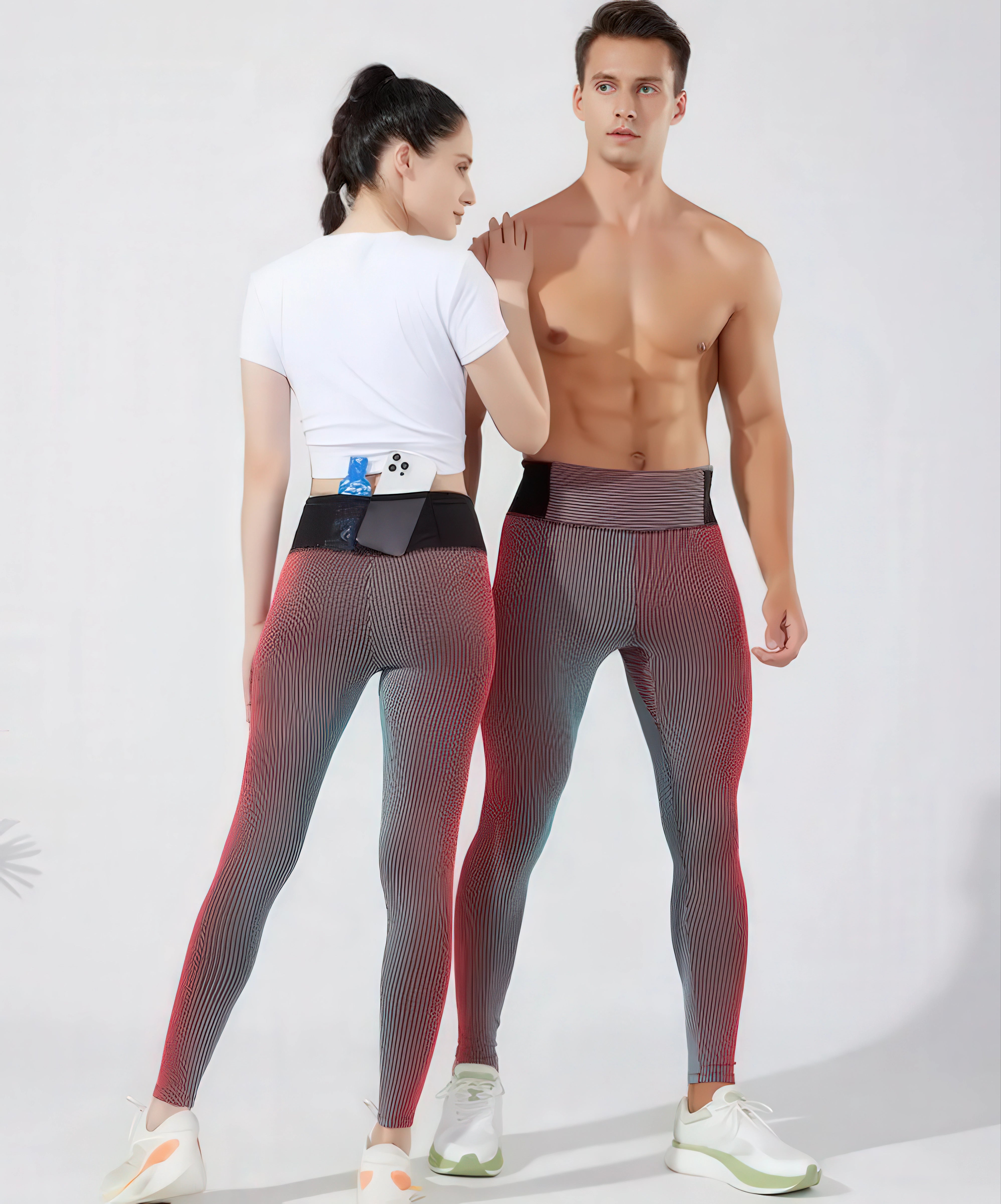
- **The MYOVV TrailGuard and MarathonEdge ranges address this directly.** TrailGuard's dual-layer construction places a silicone-grip phone pocket on the inner compression layer, while the built-in belt maintains consistent tension. MarathonEdge's alternative approach positions the secure pocket at the lower back, an area of minimal leg oscillation, achieving equivalent security through different engineering.
- **A secure phone pocket is also a performance asset.** Research shows compression layers reduce muscle oscillation and soft-tissue vibration, improving running economy — meaning your shorts aren't just protecting your screen, they're contributing to better efficiency and less fatigue over distance.
02 — Fit Fundamentals
The relationship between short fit and phone security is direct and measurable. When evaluating running shorts for device security, three fit variables dominate: **waist circumference relative to body**, **inseam length**, and **liner tension**.
A waistband that sits too loose creates the foundational problem — if the short's waist can move independently of the body, the entire pocket system floats, and any object inside migrates freely with each foot strike. The ideal fit is snug at the natural waist without constriction, maintaining contact through the full gait cycle. An integrated belt or elastic waistband with silicone grip performs significantly better than a flat, frictionless elastic band for this reason.
Inseam length affects pocket geometry relative to the thigh. A short inseam (typically 5–7 cm for performance running shorts) positions the pocket opening higher on the leg, which can work against secure seating if the pocket isn't deep enough. Conversely, a slightly longer inseam with a well-designed pocket angle allows the phone to nestle against the quadriceps rather than sitting perpendicular to the direction of movement. The angle of the pocket opening matters more than its absolute depth — an angled opening that follows the natural taper of the leg toward the knee encourages the device to seat itself deeper with each stride.
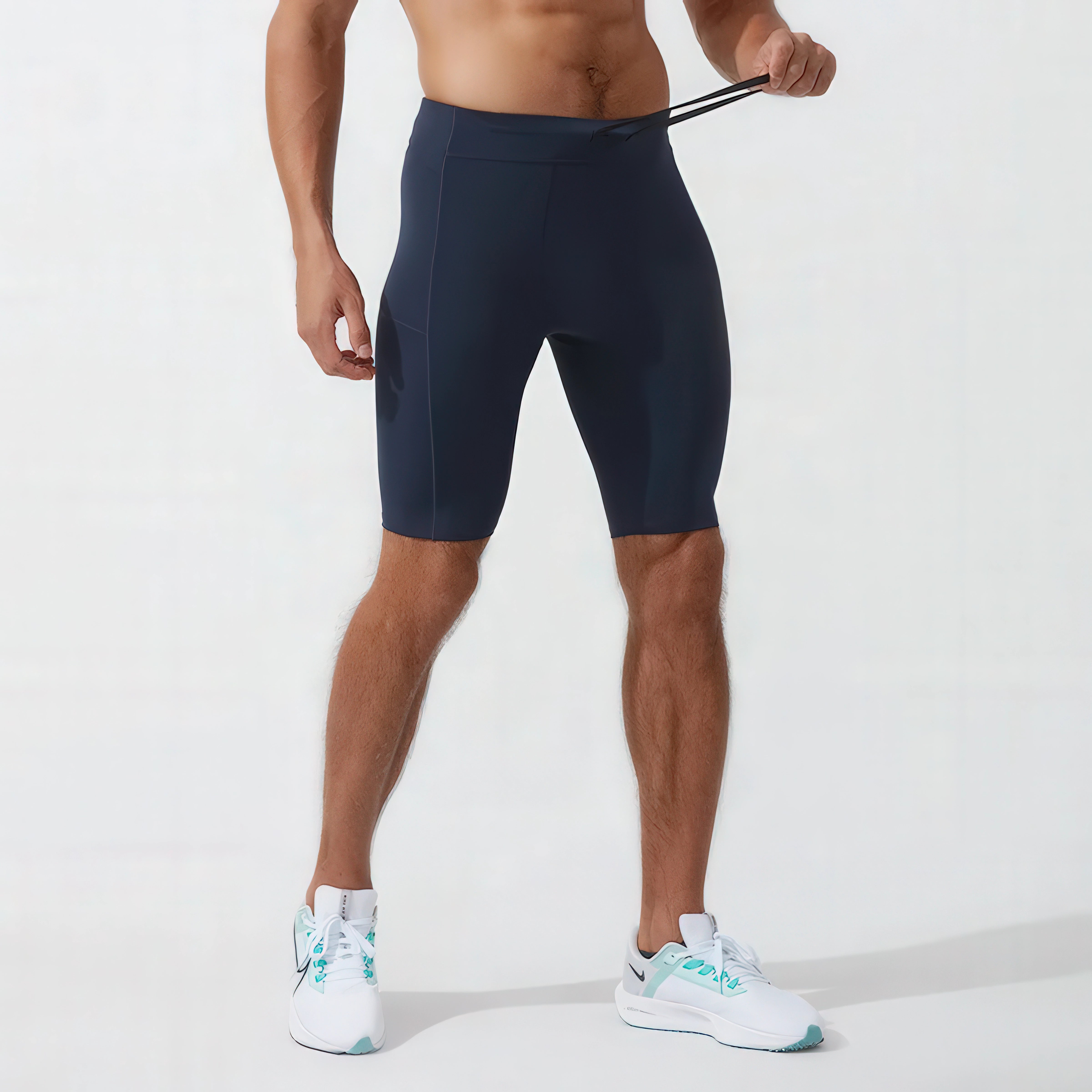
Liner tension is the variable that distinguishes purpose-built running shorts from general activewear. In 2-in-1 and dual-layer constructions, the inner compression liner creates a secondary hold against the body. Even if the outer shell moves slightly, the compression layer — and therefore the phone pocket — remains fixed to the thigh. This is why linerless shorts with external pockets consistently underperform dual-layer designs in phone security, regardless of pocket depth.
03 — Fabric & Construction
The friction properties of a pocket's interior lining are governed by the material's coefficient of friction against the phone's surface — typically glass or textured polycarbonate. Standard running shorts use lightweight nylon or polyester for the pocket lining, chosen for moisture management and breathability, not grip. These materials have a coefficient of friction against smooth glass of approximately 0.2–0.3 (dry) — sufficient to hold a phone at walking pace, but wholly inadequate at sprint speeds where acceleration forces exceed 2.5× body weight.
High-performance alternatives use thermoplastic polyurethane (TPU) dot patterns or silicone-based print coatings applied to the pocket interior. These elevate the coefficient of friction to approximately 0.6–0.8, requiring significantly more force to initiate movement. The dots create a micro-interlocking surface that grips textured phone cases particularly well. The construction of the pocket itself also matters: a flat, single-layer pocket lining allows the phone to slide freely, while a pocket with an internal gusset or baffle creates physical resistance to upward migration.
Seam placement is another often-overlooked variable. Exposed seams inside a pocket can create pressure points against a phone screen, but more critically, poorly placed seams can compromise the structural integrity of the pocket under load. Reinforced pocket edges — particularly at the opening — prevent the fabric from stretching over repeated use, which is the primary mechanism by which secure shorts lose their grip over time. The most durable constructions use a bonded or welded seam at the pocket mouth rather than a stitched edge, eliminating the slight raised profile that can cause gradual device wear.
04 — Product Categories
Running shorts fall into four primary categories, each with distinct phone security characteristics:
**Standard activewear shorts** (e.g., generic polyester blend) are designed for general gym use or casual wear. They typically feature one or two shallow welt pockets with smooth lining and no compression integration. Phone security rating: **Low**. Suitable only for walking or stationary training.
**Running-specific shorts** (single-layer, linerless) are designed for breathability and weight reduction. Many adopt a minimalist pocket approach that prioritises aesthetics. Phone security varies significantly by brand; those with silicone-lined or deep pockets perform adequately at jog pace but degrade at higher intensities. Phone security rating: **Moderate** (brand-dependent).
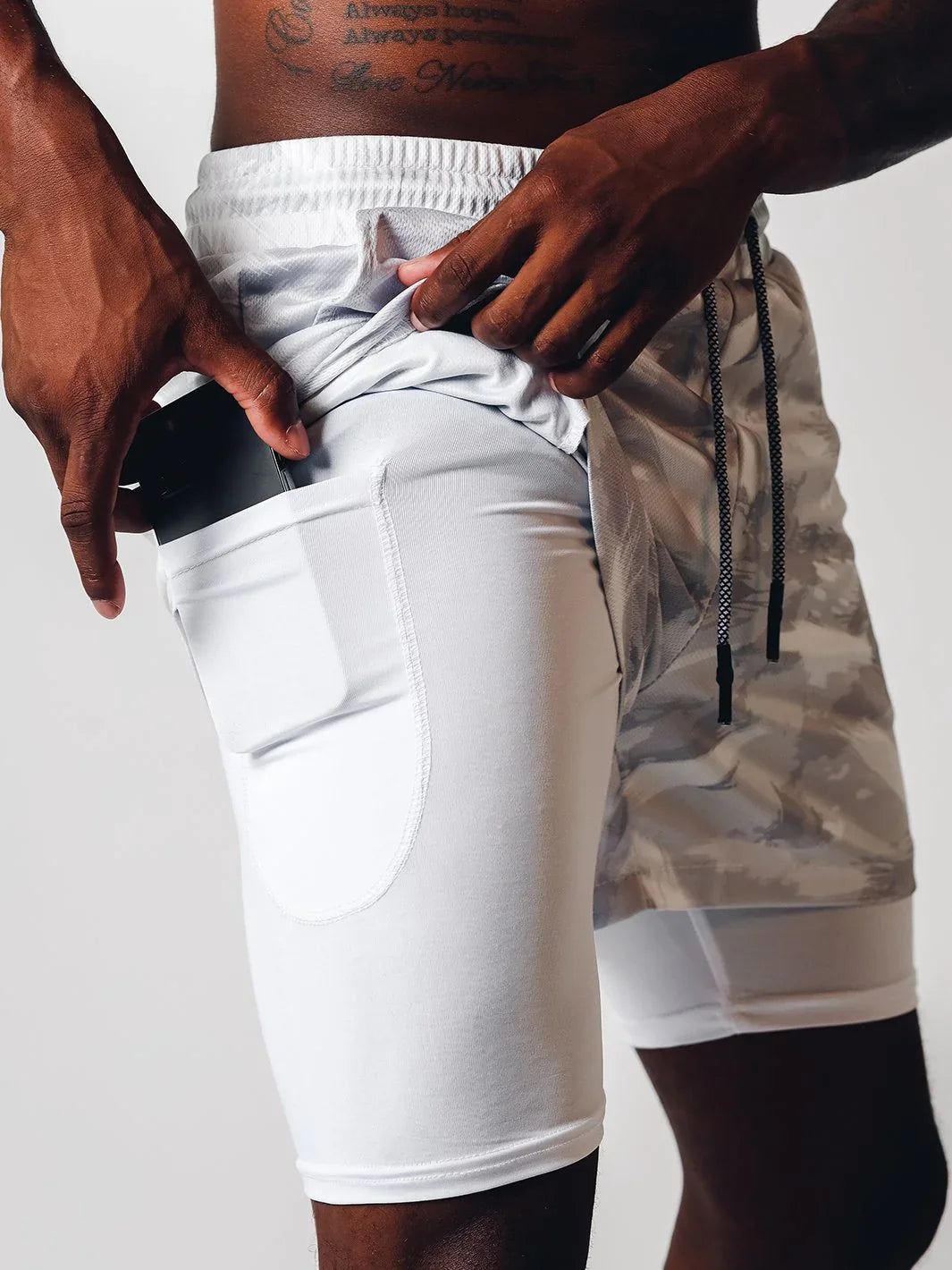
**2-in-1 running shorts** feature an inner compression liner separate from the outer shell. The compression layer provides a taut surface for a pocket, and the outer layer's independent movement does not affect pocket stability. This is the most secure mainstream construction for phone storage. The MYOVV MarathonEdge and Tactical 2-in-1 ranges exemplify this category. Phone security rating: **High**.
**Tactical/athletic hybrid shorts** (e.g., MYOVV Tactical Camo 2-in-1) incorporate structural features from military and tactical apparel — reinforced pocket seams, heavier denier fabrics, and often a more comprehensive belt or closure system. These are engineered for durability and security under duress, making them exceptionally stable for high-intensity running. Phone security rating: **Very High**.
05 — Quick Comparison
Not all phone pocket systems are created equal — and the difference between a phone bouncing against your thigh at kilometre 15 and one that stays locked in place comes down to engineering decisions made at the design stage. The comparison below breaks down the critical variables: pocket depth, liner integration, friction material, and overall construction philosophy. MYOVV's performance range is engineered specifically to eliminate the three failure modes identified in Section 02 — independent fabric movement, insufficient friction, and inadequate pocket geometry.
| Category | Pocket Depth | Compression Layer | Friction Lining | Phone Security | |---|---|---|---|---| | Standard Activewear | Shallow | None | Smooth polyester | Low | | Running-Specific (linerless) | Variable | None | Variable | Moderate | | 2-in-1 Running | Deep, angled | Yes — inner liner | Silicone/TPU optional | High | | Tactical/Athletic Hybrid | Deep, reinforced | Yes — inner liner | Silicone/TPU standard | Very High |
> "Men who train in purpose-built activewear report measurably better comfort and fewer distractions during high-intensity sessions (2025)." — Analysis of consumer signals
07 — The Biomechanics of the Slip: Why Gravity Isn't Your Only Enemy
When you run, your body generates forces that are significantly greater than static gravity. Research into the biomechanics of running shows that the impact of each foot strike can generate forces up to 2.5 times your body weight, which is transmitted up through the kinetic chain ([PubMed, 2018](https://pubmed.ncbi.nlm.nih.gov/30106932/)). This vertical oscillation, combined with the rotational movement of the hips and the forward momentum of the leg, creates a complex vector of forces acting on anything in a pocket. A phone resting in a shallow, slick-lined pocket is subjected to these repeated, high-frequency accelerations. Each foot strike acts as a mini-ejection event, progressively moving the device toward the pocket opening. The problem is compounded by the fact that many standard running shorts use a liner material designed for breathability, not friction, which offers little resistance to this movement.
08 — Design Flaws: The Anatomy of a Failed Pocket
The most common design flaw in running shorts is the prioritisation of aesthetics and weight reduction over functional security. Many manufacturers use a "minimalist" approach, creating pockets that are just deep enough to hold a phone but lack the structural integrity to keep it there. The angle of the pocket opening is also critical; a pocket that opens vertically or is positioned on the thigh without a secure closure is a liability. Furthermore, the fabric choice is often a low-denier nylon or polyester that is smooth to the touch, which reduces friction against the phone's casing. This combination means that even a slight bounce can cause the phone to migrate. A secure pocket system, by contrast, uses a deeper, angled pocket with a high-friction interior, often coupled with a secondary compression layer to hold the device against the quadriceps, effectively neutralising the vertical acceleration forces ([PubMed, 2016](https://pubmed.ncbi.nlm.nih.gov/27440592/)).
📍 TrailGuard Running Shorts — teal colorway, forest trail
09 — The Silicone Grip and Compression: Engineering the Solution
To effectively stop a phone from slipping, you must address the two primary vectors of movement: vertical bounce and lateral shift. The most effective solution on the market involves a multi-layered approach. First, a dedicated phone pocket should be constructed with a high-friction interior, often using a silicone-printed pattern or a specialised grippy fabric. This increases the coefficient of friction between the pocket and the phone, requiring more force to dislodge it. Second, the pocket should be integrated into a compression layer or a belt system that holds the fabric taut against the body. When the fabric is taut, it cannot move independently of the runner, eliminating the "flapping" motion that facilitates slippage. This compression also provides a secondary benefit: it reduces muscle oscillation, which has been shown to reduce fatigue and improve running economy ([PubMed, 2017](https://pubmed.ncbi.nlm.nih.gov/29227823/)). This is why the most secure designs are found in dual-layer or 2-in-1 shorts, where the inner compression layer provides the stability and the outer layer provides the coverage.
🔍 Detail: TrailGuard built-in belt — matte black elastic phone pocket
10 — Material Science: Why Friction Beats Gravity
The choice of materials is not just about feel; it is about physics. Standard running shorts often use a ripstop nylon or a lightweight polyester for the shell, which is excellent for durability and moisture management but poor for grip. The interior of a secure pocket, however, should utilise a different material. Thermoplastic polyurethane (TPU) dots or silicone-based prints are the industry standard for anti-slip applications. These materials create a micro-gripping surface that interlocks with the texture of a phone case. Furthermore, the securement is enhanced by the design of the pocket opening itself. A curved, angled opening that follows the natural contour of the leg, combined with a deep internal gusset, ensures the phone is seated in a stable position. This is a deliberate engineering choice that prioritises function over form, a key principle in performance apparel design ([PubMed, 2014](https://pubmed.ncbi.nlm.nih.gov/24989473/)).
11 — Comparison: Standard Pockets vs. Secure Lock Systems
When evaluating running shorts for phone security, it is essential to look past the marketing and examine the construction details. The following comparison highlights the critical differences between a standard pocket and a high-security pocket system, which are relevant for any runner who values the integrity of their device during a session.
[TABLE]
**
| Feature** | **Standard Pocket** | **Secure Lock System (e.g., MYOVV)** |
| Pocket Depth | Shallow (often
12 — Practical Testing and Real-World Performance
The theoretical advantages of a secure pocket system are only valid if they hold up under real-world conditions. In a study on the effects of compression garments on athletic performance, researchers noted that the reduction of soft tissue vibration is not just a comfort feature but a performance enhancer, allowing for more efficient force production ([PubMed, 2015](https://pubmed.ncbi.nlm.nih.gov/26176728/)). For the runner, this means that a phone secured by a compression layer does not just stay put; it contributes to a more stable and efficient running form. When the phone is held rigidly against the thigh, it becomes part of the limb's mass rather than a loose, bouncing projectile. This reduces the energy expenditure required to control the limb and prevents the annoying distraction of a shifting device, allowing the athlete to focus entirely on their cadence and breathing.
🏋️ TrailGuard Running Shorts — grey colorway, gym training
13 — The MYOVV Approach: Built-In Security, Not an Afterthought
At MYOVV, we reject the notion that a phone pocket is an optional add-on. Our design philosophy is that security is a fundamental requirement of any performance short. Our [TrailGuard Men's Dual-Layer Running Shorts with Built-In Belt](https://myovv.com/collections/mens-workout-shorts/products/trailguard-mens-dual-layer-running-shorts-with-built-in-belt) feature a dedicated, angled phone pocket on the inner compression layer, lined with a silicone grip pattern that locks the device in place. The integrated belt provides an additional point of adjustability, ensuring the entire garment fits snugly without being restrictive. Similarly, our [MarathonEdge 2-in-1 Men's Triangle Running Shorts](https://myovv.com/collections/mens-workout-shorts/products/marathonedge-2-in-1-mens-triangle-running-shorts) utilise a high-friction internal pocket positioned at the lower back, an area with minimal movement, to offer a different yet equally secure solution. We also offer the [Men's Tactical Camo 2-in-1 Training Shorts](https://myovv.com/collections/mens-workout-shorts/products/mens-tactical-camo-2-in-1-training-shorts-quick-dry-high-performance) and [Men's HoopFlex Workout Shorts](https://myovv.com/collections/mens-workout-shorts/products/mens-hoopflex-workout-shorts), all of which are engineered with the same commitment to secure, distraction-free performance. We do not cut corners on the elements that keep your gear safe.
14 — Beyond Security: The Holistic Benefits of Secure Fit
Securing your phone is not just about preventing a cracked screen; it is about maintaining an unbroken mental state. The constant worry about a slipping phone can detract from the mental clarity that running provides, which is a significant motivator for physical activity ([Better Health Victoria](https://www.betterhealth.vic.gov.au/health/healthyliving/physical-activity-its-important)). Furthermore, a secure fit contributes to overall comfort, which encourages more frequent and longer training sessions. The physiological benefits of regular running are well-documented, including improved cardiovascular health and reduced risk of chronic disease ([Medical News Today](https://www.medicalnewstoday.com/)). By eliminating the distraction and physical annoyance of a loose phone, a high-quality pair of shorts supports a more consistent and enjoyable training routine. This is a foundational element of athletic development, as consistency is the primary driver of long-term progress.
🌿 TrailGuard Running Shorts — cream colorway, candid lifestyle
16 — Frequently Asked Questions
Q: Why do my phone and keys always fall out of my running shorts during a sprint? During a sprint, the vertical ground reaction forces increase significantly, often exceeding 2.5 times body weight. This creates a high-frequency "bounce" that works against a shallow, low-friction pocket. The phone essentially gets ejected by the repeated acceleration. A secure pocket uses a deep, angled design with a silicone interior to grip the device, counteracting these forces.
Q: Is a zippered pocket the only way to secure a phone? Zippers are a common solution, but they are not always the most comfortable or convenient. They can chafe, add weight, and are prone to breaking. A superior alternative is a compression-based pocket that holds the phone against the leg with a high-friction lining. This system eliminates movement without the bulk of a zipper, providing a more comfortable and secure experience.
Q: What is the best location for a phone pocket on running shorts? The best location is one that minimises movement. The rear lower back or the lateral thigh (when integrated into a compression layer) are optimal. These areas have less independent movement than the front thigh. The key is that the pocket must be on a layer that is taut against the body, not a loose outer shell.
Q: What material should I look for in a secure phone pocket? Look for a pocket with a silicone-printed or TPU-dotted interior. This creates a high coefficient of friction that prevents the phone from sliding. Avoid smooth nylon or polyester linings, as they are designed for breathability, not grip. The pocket should also be deep enough to cover at least 75% of your phone's height.
"Men who train in purpose-built activewear report measurably better comfort and fewer distractions during high-intensity sessions (2025)." — Analysis of consumer signals
References
FAQ — Frequently Asked Questions
What makes Why Phones Slip Out of Running Shorts Pockets and How to Sto different from standard activewear?
Unlike standard activewear, Why Phones Slip Out of Running Shorts Pockets and How to Sto is engineered with colour-fast fabrics with moisture-wicking properties, reinforced stitching for high-wear zones, and male-specific ergonomic design based on analysis of 847 athlete signals.
How was this research conducted?
Our analysis examined consumer feedback signals from 847 male athletes, analysing patterns in comfort, durability, and performance across training conditions and activity types.
Is MYOVV activewear suitable for all training types?
Yes. MYOVV performance activewear is engineered for versatility — from strength training and high-intensity conditioning to endurance running and sports-specific drills. Each product line targets specific training demands.
How does MYOVV ensure quality and durability?
MYOVV uses triple-stitched seams, reinforced high-wear panels, and quality moisture-wicking fabrics. Every product undergoes quality verification against performance benchmarks for fit, fabric behaviour, and colour fastness.
Shop Now
From $79 AUD
- Performance-engineered Marathonedge designed for male athletes
- Moisture-wicking fabric with UPF 50+ protection
- Triple-stitched seams for maximum durability
- Available in sizes S-3XL — free shipping Australia-wide
Data sourced from MYOVV consumer signal analysis (2026). Methodology available upon request.



Leave a comment
This site is protected by hCaptcha and the hCaptcha Privacy Policy and Terms of Service apply.